
Substitute Form 3520-A
A substitute Form 3520-A is filed by a U.S. owner when a foreign trust fails to file its annual return, and it carries its own timing and statement rules. Timing and statements are tied to Forms 3520 and 3520-A.
Definition and place on the form
The Instructions for Form 3520-A describe a substitute Form 3520-A as a return that a U.S. owner completes for a foreign trust when the trust fails to file Form 3520-A. The Instructions for Form 3520 describe it as an attachment to the owner's Form 3520.[1][2]
Form 3520-A is the foreign trust's annual information return when it has at least one U.S. owner. It reports information about the trust, its U.S. beneficiaries, and U.S. persons treated as owners under the grantor trust rules. The substitute filing carries that reporting into the U.S. owner's Form 3520 filing when the trust's return is missing.[2]
The instructions place the substitute option among the boxes for return status. A U.S. owner filing it with Form 3520 checks the box labeled "Substitute Form 3520-A." This identifies the attached return as the substitute filing.[2]
Who files and what accompanies it
The foreign trust with a U.S. owner is responsible for filing the regular Form 3520-A and furnishing annual statements. Each U.S. person treated as an owner is responsible for ensuring the trust files and provides those statements. If the trust does not file, the U.S. owner completes the substitute form and attaches it to Form 3520.[2]
The substitute filing includes the Foreign Grantor Trust Owner Statement and Foreign Grantor Trust Beneficiary Statement. The owner must also provide copies of those statements to the U.S. owners and beneficiaries by the Form 3520 due date. These statements are parts of Form 3520-A and carry information for the respective U.S. recipients.[2]
The U.S. owner signs the substitute Form 3520-A, and the owner's name and taxpayer identification number go on the title line in the signature box. The regular trust-filed Form 3520-A, by contrast, is signed by the trust's trustee.[2]
Timing and related reporting
The regular Form 3520-A is generally due by the fifteenth day of the third month after the trust tax year ends. When that day falls on a weekend or legal holiday, the due date moves to the next business day. For a calendar-year trust, the nominal due date is March 15. With a timely Form 7004, the extension is six months, which is September 15 for a calendar-year trust. A substitute filed with the U.S. owner's Form 3520 follows the Form 3520 due date instead. The instructions describe completion to the best of the owner's ability by that due date as timely filing.[2]
An extension for an income tax return does not extend the Form 3520-A filing time. The trust may request an extension for its own return using Form 7004 and the trust's employer identification number. That trust filing route is distinct from the substitute return attached to the owner's Form 3520.[2]
A U.S. owner's and beneficiary's tax returns generally follow the treatment on the trust's Form 3520-A. If an item is treated differently, the instructions identify Form 8082 for reporting the inconsistent treatment.[2]
Exceptions and limits
The instructions describe exemptions from foreign trust information reporting for certain Canadian retirement plans and for certain eligible individuals' transactions with, or ownership of, specified tax-favored foreign trusts. The stated benefit purposes include retirement, medical, disability, or educational benefits.
The IRS instructions state that these foreign trust reporting exemptions do not affect obligations under section 6038D or other U.S. law provisions.
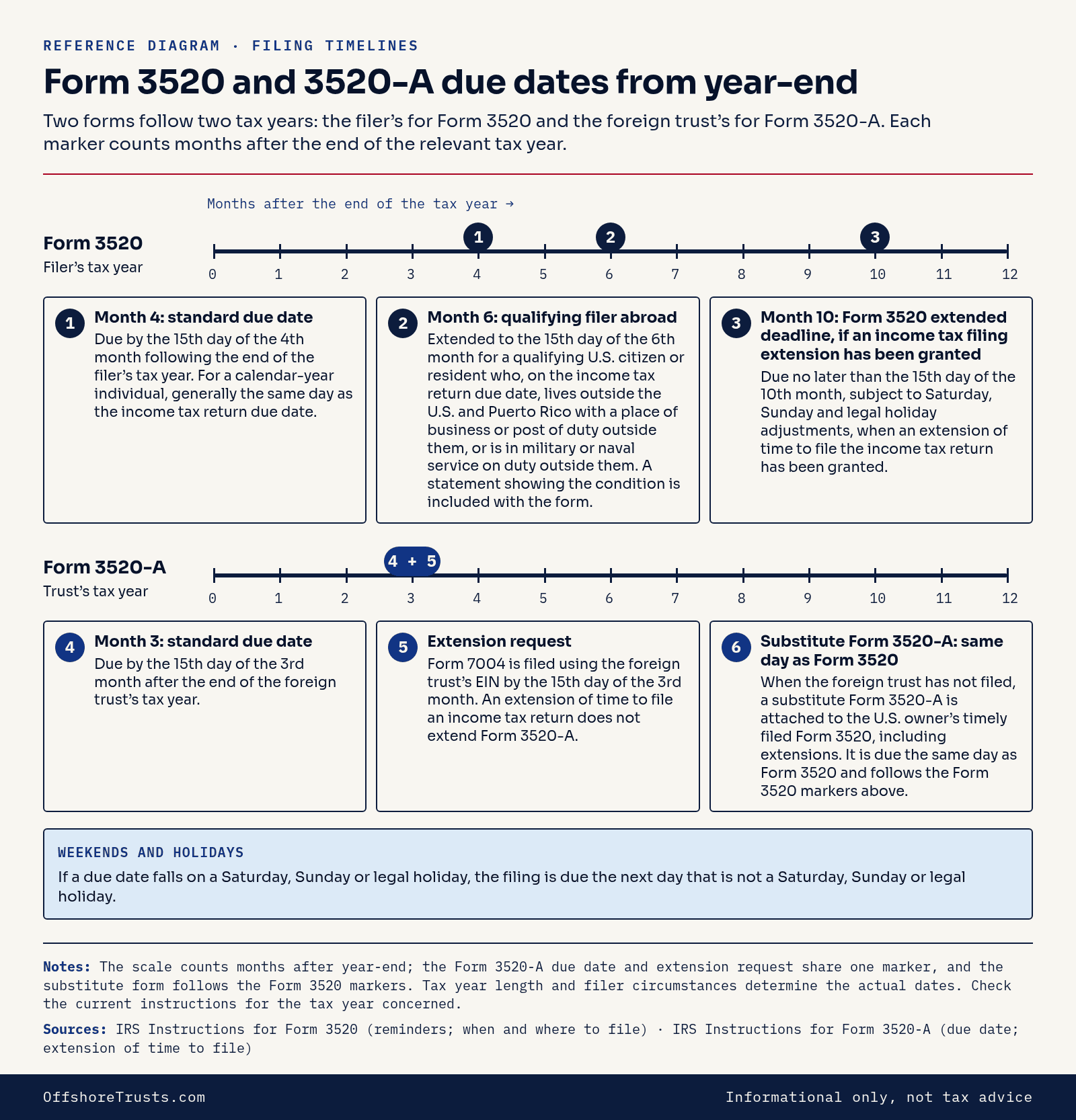
Data table for this infographic
| Form | Tax year used | Due date or condition | Description |
|---|---|---|---|
| Form 3520 | The filer's own tax year | Month 4: standard due date | Due by the 15th day of the 4th month following the end of the filer's tax year. For a calendar-year individual, generally the same day as the income tax return due date. |
| Form 3520 | The filer's own tax year | Month 6: qualifying filer abroad | Extended to the 15th day of the 6th month for a qualifying U.S. citizen or resident who, on the income tax return due date, lives outside the U.S. and Puerto Rico with a place of business or post of duty outside them, or is in military or naval service on duty outside them. A statement showing the condition is included with the form. |
| Form 3520 | The filer's own tax year | Month 10: Form 3520 extended deadline, if an income tax filing extension has been granted | Due no later than the 15th day of the 10th month, subject to Saturday, Sunday and legal holiday adjustments, when an extension of time to file the income tax return has been granted. |
| Form 3520-A | The foreign trust's tax year | Month 3: standard due date | Due by the 15th day of the 3rd month after the end of the foreign trust's tax year. |
| Form 3520-A | The foreign trust's tax year | Extension request | Form 7004 is filed using the foreign trust's EIN by the 15th day of the 3rd month. An extension of time to file an income tax return does not extend Form 3520-A. |
| Substitute Form 3520-A | Follows the filer's Form 3520 timeline | Same day as Form 3520 | When the foreign trust has not filed, a substitute Form 3520-A is attached to the U.S. owner's timely filed Form 3520, including extensions. It is due the same day as Form 3520 and follows the Form 3520 markers above. |
| All forms | The tax year used for each form | Weekends and holidays | If a due date falls on a Saturday, Sunday or legal holiday, the filing is due the next day that is not a Saturday, Sunday or legal holiday. |
| Notes | The filer's or the foreign trust's tax year, depending on the form | Scope | The scale counts months after year-end; the Form 3520-A due date and extension request share one marker, and the substitute form follows the Form 3520 markers. Tax year length and filer circumstances determine the actual dates. The instructions for the tax year concerned govern. |
| Sources | Forms 3520 and 3520-A | Documents | IRS Instructions for Form 3520 (reminders; when and where to file) · IRS Instructions for Form 3520-A (due date; extension of time to file) |
Questions and answers
Who files a substitute Form 3520-A?
The U.S. owner files it when the foreign trust fails to file Form 3520-A. The owner attaches it to the owner's Form 3520.[2]
What statements go with the substitute return?
It includes the Foreign Grantor Trust Owner Statement and Foreign Grantor Trust Beneficiary Statement. The owner also provides copies to U.S. owners and beneficiaries by the Form 3520 due date.[2]
When is the substitute filing due?
It is due with the U.S. owner's Form 3520, by that form's due date. The regular trust-filed Form 3520-A has a separate due date tied to the trust tax year.[2]
Who signs the substitute form?
The U.S. owner signs it. The owner's name and taxpayer identification number are entered on the title line of the signature box.[2]
Does an income tax return extension extend Form 3520-A time?
No. The instructions state that an extension for an income tax return does not extend the Form 3520-A filing time. Form 7004 is used to request an extension for the trust's Form 3520-A.[2]
Related terms
- Foreign grantor trust owner statement: The Instructions for Form 3520-A identify the Foreign Grantor Trust Owner Statement as pages 3 and 4 of the foreign trust's annual information return.
- Foreign grantor trust beneficiary statement: A foreign grantor trust beneficiary statement appears on page 5 of Form 3520-A. It reports distributions to U.S. beneficiaries and identifies the trust's owner.
- U.S. owner of a foreign trust: The Form 3520 instructions define a U.S. owner as a person treated as owning trust assets under grantor trust rules. Ownership can apply to part of a trust.
- Foreign grantor trust: A foreign grantor trust is a foreign trust treated as owned by a grantor, often a U.S. person. Ownership brings Form 3520 and Form 3520-A reporting duties.
Related guides and articles
- Foreign trust forms and the accounts behind them: Forms 3520 and 3520-A cover transfers to a foreign trust, its ownership and its distributions. Bank accounts behind a trust add separate FBAR and 8938 rules.
- Tax planning and compliance for foreign trusts: U.S. rules classify trusts and assign tax and reporting duties to U.S. citizens connected with foreign trusts, including forms, filing calendars and records.
- Section 6048 reporting for certain foreign trusts: Section 6048 foreign trust reporting for U.S. citizens, including definitions and reportable events, as well as ownership and distributions and the IRS forms.
Related pages
Sources and data notes
- Internal Revenue Service, Instructions for Form 3520. https://www.irs.gov/instructions/i3520. Retrieved .
- Internal Revenue Service, Instructions for Form 3520-A. https://www.irs.gov/instructions/i3520a. Retrieved .
- Internal Revenue Service, 26 CFR 301.7701-7 Trusts, domestic and foreign. https://ecfr.io/Title-26/Section-301.7701-7. Retrieved .
- Internal Revenue Service, 26 CFR 301.7701-4 Trusts. https://www.ecfr.gov/current/title-26/section-301.7701-4. Retrieved .
- Internal Revenue Service, 26 U.S.C. 679. https://uscode.house.gov/us/usc/119-118/t26/s679/. Retrieved .
- Internal Revenue Service, 26 U.S.C. 6048. https://uscode.house.gov/us/usc/119-118/t26/s6048/. Retrieved .
- Internal Revenue Service, Foreign trust reporting requirements and tax consequences. https://www.irs.gov/businesses/international-businesses/foreign-trust-reporting-requirements-and-tax-consequences. Retrieved .
Dates in this block record when each source was read for this page.