
Foreign grantor trust
A foreign grantor trust is a foreign trust treated as owned, in whole or in part, by someone other than the trust. The Form 3520 instructions tie that status to U.S. ownership rules and reporting duties.
Meaning in the reporting instructions
A foreign grantor trust is a foreign trust whose assets are treated for U.S. income tax purposes as owned, in whole or in part, by a person other than the trust, usually the grantor. A foreign trust to which none of the ownership rules apply is a foreign nongrantor trust.
Subject to exceptions, section 679 generally treats a U.S. transferor as the owner of the portion attributable to transferred property for any year in which the foreign trust has a U.S. beneficiary. Foreign-person ownership requires a separate analysis under section 672(f), which limits the application of the grantor-trust rules and provides exceptions. Foreign classification alone does not establish grantor status, and ownership can apply to only a portion of a trust.[5]
How foreign status is determined
The term depends on whether the trust is foreign, a classification determined under the court and control tests. A trust is domestic only if a U.S. court can exercise primary supervision over its administration and U.S. persons control all substantial decisions. Trustee address, governing law or asset location alone does not settle classification. Limited rules provide a 12-month opportunity to correct qualifying inadvertent changes affecting control. This opportunity does not apply automatically to every change.[3]
An arrangement is generally a trust when trustees take title to property to protect or conserve it for beneficiaries, subject to the regulation's treatment of business arrangements.[4]
Reporting and related terms
Form 3520-A is the foreign trust's annual information return, and the trust furnishes a Foreign Grantor Trust Owner Statement to each U.S. owner. When the trust does not file, the U.S. owner may file a substitute Form 3520-A with Form 3520.[2]
Related reading
The Foreign Grantor Trust Owner Statement and the Foreign Grantor Trust Beneficiary Statement are separate reporting documents associated with Form 3520-A. Substitute Form 3520-A covers the return a U.S. owner must attach to Form 3520 when the foreign trust fails to file Form 3520-A. The meaning of "foreign" is addressed separately in Foreign trust, while Grantor explains the person connected to creating or transferring property to a trust.
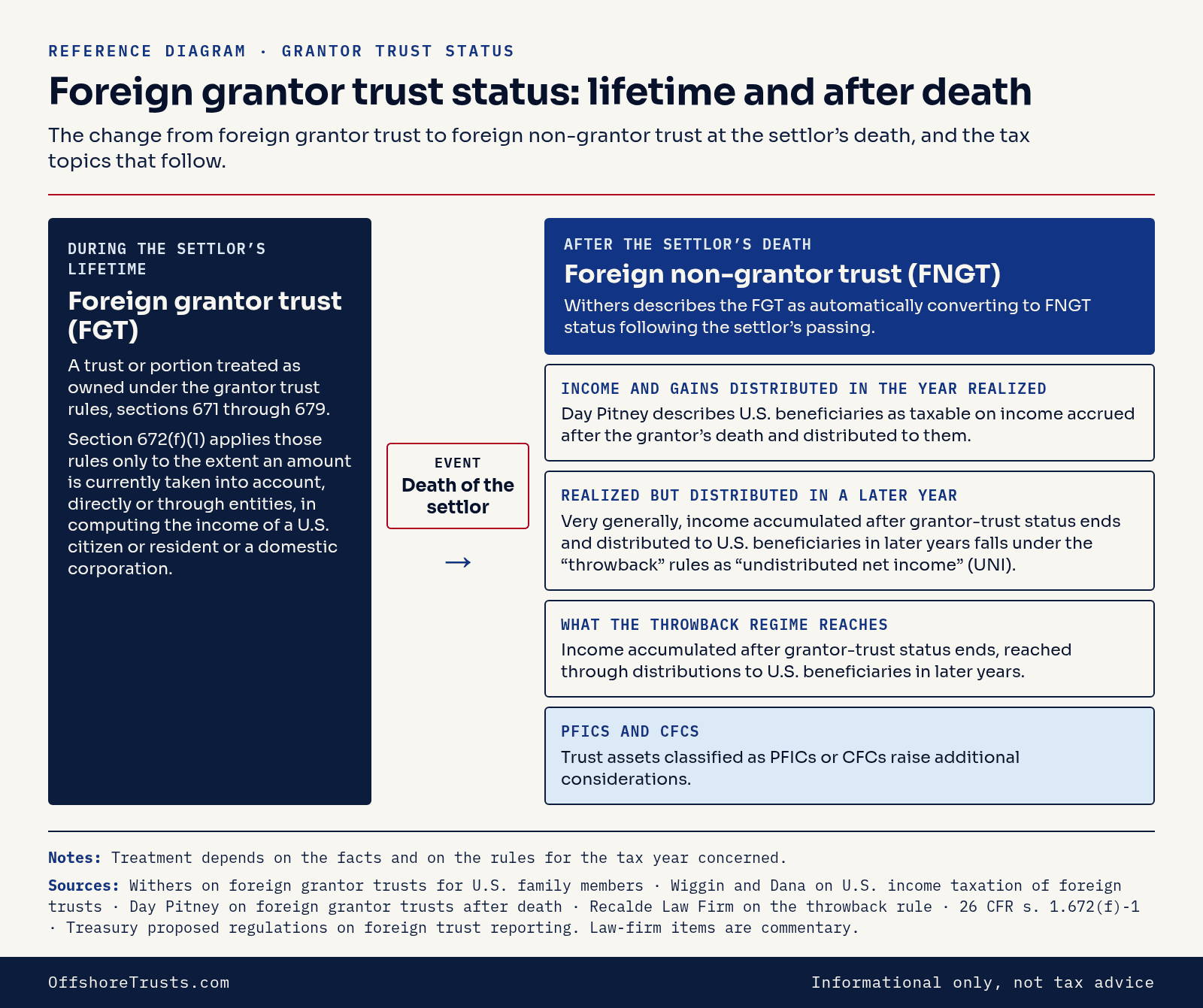
Data table for this infographic
| Stage or topic | Status or event | Description | Tax treatment or reporting |
|---|---|---|---|
| During the settlor's lifetime | Foreign grantor trust (FGT) | A trust or portion treated as owned under the grantor trust rules, sections 671 through 679. | Section 672(f)(1) applies those rules only to the extent an amount is currently taken into account, directly or through entities, in computing the income of a U.S. citizen or resident or a domestic corporation. |
| Event | Death of the settlor | Grantor trust status generally ends at the settlor's death. | |
| After the settlor's death | Foreign non-grantor trust (FNGT) | The trust generally becomes a foreign non-grantor trust after the settlor's death. | |
| What the throwback regime reaches | Income accumulated after grantor-trust status ends, reached through distributions to U.S. beneficiaries in later years. | ||
| Notes | Treatment depends on the facts and on the rules for the tax year concerned. | ||
Income and gains distributed in the year realized: Distributions to U.S. beneficiaries of income accrued after the grantor's death are generally included in their income under the rules for foreign non-grantor trusts.
Realized but distributed in a later year: Very generally, income accumulated after grantor-trust status ends and distributed to U.S. beneficiaries in later years falls under the "throwback" rules as "undistributed net income" (UNI).
PFICs and CFCs: Trust assets classified as PFICs or CFCs raise additional considerations.
Questions and answers
Does every transfer to a foreign trust make the U.S. person its owner?
Section 679 generally applies when a U.S. person transfers property and a U.S. person may benefit. The statute includes exceptions, including specified transfers for fair market value.[5]
What reporting relates to a foreign grantor trust?
Form 3520 covers reporting by the U.S. owner, and Form 3520-A is the foreign trust's annual information return. The owner may file a substitute Form 3520-A with Form 3520 when the trust does not file.[2]
Related terms
- Foreign trust: For federal tax purposes, a trust is foreign if it fails either the court test or the control test. The tests concern U.S. court oversight and decision control.
- Domestic trust: The IRS defines a domestic trust through its court test and control test, and the term appears in U.S. foreign trust reporting rules for U.S. citizens.
- Foreign trust classification: A trust is foreign under Form 3520 when it fails either domestic trust test. The tests ask about U.S. court supervision and control of substantial decisions.
- U.S. person: A U.S. person includes a U.S. citizen or resident alien, a domestic partnership or corporation, a domestic trust, or an estate other than a foreign estate.
Related guides and articles
- The court and control tests for foreign trusts: The court test and the control test classify a trust as domestic or foreign, and foreign trust status connects to U.S. reporting rules for U.S. citizens.
- Section 679 and foreign trusts with U.S. beneficiaries: Section 679 covers ownership treatment, U.S. beneficiaries, transfer exceptions and related reporting rules for foreign trusts connected to U.S. citizens.
- Section 6048 reporting for certain foreign trusts: Section 6048 foreign trust reporting for U.S. citizens, including definitions and reportable events, as well as ownership and distributions and the IRS forms.
Related pages
Sources and data notes
- Internal Revenue Service, Instructions for Form 3520. https://www.irs.gov/instructions/i3520. Retrieved .
- Internal Revenue Service, Instructions for Form 3520-A. https://www.irs.gov/instructions/i3520a. Retrieved .
- Internal Revenue Service, 26 CFR 301.7701-7 Trusts, domestic and foreign. https://ecfr.io/Title-26/Section-301.7701-7. Retrieved .
- Internal Revenue Service, 26 CFR 301.7701-4 Trusts. https://www.ecfr.gov/current/title-26/section-301.7701-4. Retrieved .
- Internal Revenue Service, 26 U.S.C. 679. https://uscode.house.gov/us/usc/119-118/t26/s679/. Retrieved .
- Internal Revenue Service, 26 U.S.C. 6048. https://uscode.house.gov/us/usc/119-118/t26/s6048/. Retrieved .
- Internal Revenue Service, Foreign trust reporting requirements and tax consequences. https://www.irs.gov/businesses/international-businesses/foreign-trust-reporting-requirements-and-tax-consequences. Retrieved .
Dates in this block record when each source was read for this page.