
Section 6048 reporting for certain foreign trusts
Section 6048 foreign trust reporting covers definitions, reportable events, ownership, distributions and IRS forms.
Definitions come first
A U.S. citizen falls within the U.S. person definition used in the IRS foreign trust reporting rules. That definition also includes U.S. residents, domestic partnerships and corporations, certain estates, and domestic trusts.[2]
The Form 3520 instructions classify a trust as foreign when it does not qualify as domestic. Domestic classification requires both a U.S. court's ability to exercise primary supervision over trust administration and authority held by one or more U.S. persons to control every substantial trust decision.[3]
A grantor includes someone who establishes a trust or contributes cash or other property without equivalent value, directly or indirectly. For foreign trust reporting, an owner is a person treated as owning trust assets under sections 671 through 679.[3]
Grantor trust treatment can apply to only part of a trust's assets. A nongrantor trust is treated as a separate taxable entity to the extent its assets are not attributed to another person under those rules.[3]
The structure of Section 6048
Section 6048 separates reporting into event notices, U.S. ownership reporting, and reporting of distributions received by U.S. persons. The information required therefore depends on the person's connection with the trust.[1]
Subsection (a) addresses specified events involving foreign trusts. Subsection (b) assigns reporting responsibilities to U.S. persons treated as owners, while subsection (c) requires returns from U.S. persons receiving distributions directly or indirectly.[1]
Events and the responsible party
Reportable events include establishing a foreign trust and transferring money or property to one by a U.S. person. Transfers can be direct or indirect, including transfers resulting from death.[1]
A U.S. citizen's or resident's death is also reportable if the person was treated as owning any portion of a foreign trust, or if any portion was included in that person's gross estate.[1]
Responsibility generally rests with the grantor when a trust is created during life and with the transferor for a reportable transfer other than one resulting from death. The estate's executor is the responsible party in the remaining statutory category.[1]
The statutory notice includes the amount transferred and identifies the trust, each trustee, and beneficiaries or beneficiary classes. The Form 3520 instructions assign reportable-event information to the relevant portions of Part I.[1][3]
Ownership creates annual reporting
U.S. ownership reporting applies when a U.S. person is treated as owning any portion of a foreign trust at any time during the person's taxable year. Section 6048(b) generally requires the U.S. owner to ensure that the foreign trust files Form 3520-A and provides annual statements to U.S. owners and U.S. persons receiving distributions directly or indirectly. Additional information required from the U.S. owner is reported on Part II of Form 3520.[1]
The trust's return accounts for its activities and operations and identifies its U.S. agent. Prescribed information also goes to U.S. owners and U.S. persons receiving distributions directly or indirectly.[1]
The IRS connects these responsibilities to Form 3520-A and the annual statements furnished to U.S. owners and beneficiaries. A U.S. owner's own Form 3520 includes Part II even when the trust had no transactions during the tax year.[2][3]
Distributions have a separate reporting rule
A U.S. person receiving a foreign trust distribution directly or indirectly reports the trust's name and the total distributions received during the taxable year. The Form 3520 instructions place distribution reporting in Part III.[1][3]
For this reporting rule, a distribution includes a gratuitous transfer from a foreign trust even when the recipient is not named as a beneficiary. It can include trust principal and constructive transfers, such as amounts spent through checks written on a foreign trust's bank account.[3]
Part III reporting can apply whether or not the amount is taxable. The instructions also provide separate entries for loans and uncompensated use of trust property.[3]
Exceptions depend on their conditions
The Form 3520 instructions exclude most fair market value transfers, while retaining reporting for specified transactions. Examples include certain transfers involving qualified obligations, appreciated property without immediate recognition of all gain, and transfers involving a related foreign trust.[3]
The IRS also identifies filing exceptions for Canadian registered retirement savings plans and registered retirement income funds. Certain other foreign retirement, medical, disability, or educational trusts qualify only when the individual and trust meet the applicable requirements.[2]
Connections to other U.S. reporting
Foreign trust reporting can extend beyond Forms 3520 and 3520-A. The IRS identifies Form 8938 reporting when specified foreign financial assets exceed applicable thresholds, and FBAR reporting may apply to foreign accounts involving a financial interest or signature authority.[2]
Exceptions from Forms 3520 and 3520-A do not remove otherwise applicable Form 8938 or FBAR obligations. The IRS also identifies Schedule B, Part III reporting for a foreign trust distribution, grantor relationship, or transfer, and possible Form 709 reporting for transfers to foreign trusts.[2]
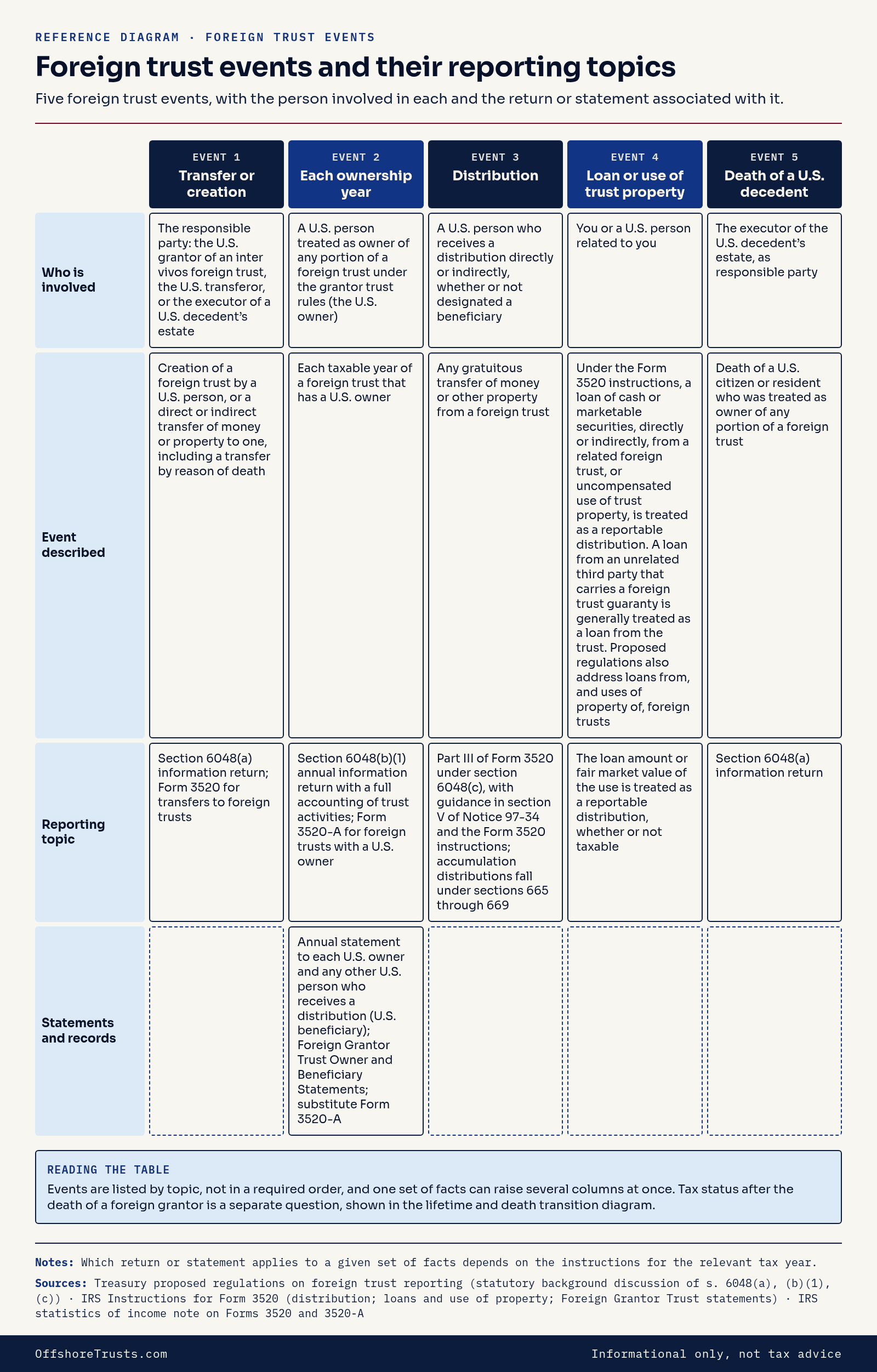
Data table for this infographic
| Event group | Event described | Who is involved | Reporting topic | Statements and records |
|---|---|---|---|---|
| Transfer or creation | Creation of a foreign trust by a U.S. person, or a direct or indirect transfer of money or property to one, including a transfer by reason of death | The responsible party: the U.S. grantor of an inter vivos foreign trust, the U.S. transferor, or the executor of a U.S. decedent's estate | Section 6048(a) information return; Form 3520 for transfers to foreign trusts | Records of the trust creation and of each direct or indirect transfer of money or property to the foreign trust, including transfers by reason of death |
| Each ownership year | Each taxable year of a foreign trust that has a U.S. owner | A U.S. person treated as owner of any portion of a foreign trust under the grantor trust rules (the U.S. owner) | Section 6048(b)(1) annual information return with a full accounting of trust activities; Form 3520-A for foreign trusts with a U.S. owner | Annual statement to each U.S. owner and any other U.S. person who receives a distribution (U.S. beneficiary); Foreign Grantor Trust Owner and Beneficiary Statements; substitute Form 3520-A |
| Distribution | Any gratuitous transfer of money or other property from a foreign trust | A U.S. person who receives a distribution directly or indirectly, whether or not designated a beneficiary | Part III of Form 3520 under section 6048(c), with guidance in section V of Notice 97-34 and the Form 3520 instructions; accumulation distributions fall under sections 665 through 669 | Annual statement to each U.S. person who receives a distribution (U.S. beneficiary) from a foreign trust with a U.S. owner; Foreign Grantor Trust Beneficiary Statement |
| Loan or use of trust property | Under the Form 3520 instructions, a loan of cash or marketable securities, directly or indirectly, from a related foreign trust, or uncompensated use of trust property, is treated as a reportable distribution. A loan from an unrelated third party that carries a foreign trust guaranty is generally treated as a loan from the trust. Proposed regulations also address loans from, and uses of property of, foreign trusts. | You or a U.S. person related to you | The loan amount or fair market value of the use is treated as a reportable distribution, whether or not taxable | Records of the loan amount, any foreign trust guaranty, or the fair market value of the use of trust property |
| Death of a U.S. decedent | Death of a U.S. citizen or resident who was treated as owner of any portion of a foreign trust | The executor of the U.S. decedent's estate, as responsible party | Section 6048(a) information return | Records supporting the decedent's treatment as owner of the foreign trust at death |
| Reading the table | Events are listed by topic, not in a required order, and one set of facts can raise several columns at once. | Tax status after the death of a foreign grantor is a separate question, shown in the lifetime and death transition diagram. | ||
Questions and answers
Does the U.S. person definition include a U.S. citizen?
U.S. citizenship is one basis for classification as a U.S. person under the IRS explanation. The definition also reaches several categories of entities, including domestic corporations and partnerships.[2]
Can I have ownership reporting without receiving a distribution?
The Form 3520 instructions require Part II for a U.S. owner even without trust transactions during the tax year. Receipt of a distribution can also create a Part III reporting requirement.[3]
What happens to reporting if the trust does not file Form 3520-A?
The IRS instructions require the U.S. owner to complete a substitute Form 3520-A and attach it to a timely Form 3520. Required annual statements also remain part of the owner's responsibilities.[2]
Does every reported distribution represent taxable income?
Part III calls for reporting distributions even when they are not taxable. The IRS describes beneficiary statements as providing information about the tax treatment of distributions received.[2][3]
Can spouses report the same foreign trust together?
The instructions permit a joint Form 3520 when spouses file a joint income tax return and both are transferors, grantors, or beneficiaries of the same foreign trust. This permission applies to their reporting for the same tax year.[3]
Related resources
Related glossary terms
- Section 679: Section 679 addresses certain transfers by U.S. persons to foreign trusts. It treats some property transfers as ownership when the trust has a U.S. beneficiary.
- Power to revoke: Section 676 defines a power to revest trust property in the grantor. When the power applies, the grantor is treated as owner of the covered trust portion.
- Adverse party: Section 672 defines an adverse party by reference to a substantial beneficial interest in a trust and the effect of a power held over it in the trust.
Related articles and guides
- 26 U.S.C. § 6048, Foreign trust information: A reference to 26 U.S.C. § 6048 for U.S. citizens, covering foreign trust events and owner and beneficiary reporting, and where to read the official text.
- IRS Foreign Trust Reporting Requirements: An IRS reference page on foreign trust reporting, income tax rules, Forms 3520 and 3520-A, and related U.S. reporting for citizens and other U.S. persons.
- Foreign trust forms and the accounts behind them: Forms 3520 and 3520-A cover transfers to a foreign trust, its ownership and its distributions. Bank accounts behind a trust add separate FBAR and 8938 rules.
Related pages
Sources and data notes
- United States Congress, Office of the Law Revision Counsel, 26 U.S.C. § 6048, Information with respect to certain foreign trusts. https://uscode.house.gov/us/usc/119-118/t26/s6048/. Retrieved .
- Internal Revenue Service, Foreign trust reporting requirements and tax consequences. https://www.irs.gov/businesses/international-businesses/foreign-trust-reporting-requirements-and-tax-consequences. Retrieved .
- Internal Revenue Service, Instructions for Form 3520 (12/2025): Annual Return To Report Transactions With Foreign Trusts and Receipt of Certain Foreign Gifts. https://www.irs.gov/instructions/i3520. Retrieved .
Dates in this block record when each source was read for this page.