
Tax planning and compliance for foreign trusts
U.S. rules classify trusts and assign tax and reporting duties. The forms, filing calendars, exceptions and records are relevant to a U.S. citizen connected with a foreign trust.
Two separate trust classifications
Tax planning here means paying the tax due and meeting the reporting duties that apply.
The domestic or foreign classification uses a court test and a control test. A domestic trust meets both tests: a U.S. court can primarily supervise its administration, and U.S. persons have authority over all substantial decisions. Other trusts are foreign.[1]
Grantor or nongrantor status is a separate question about ownership under the grantor trust rules. A trust can be partly grantor and partly nongrantor. A U.S. owner generally reports income attributable to the portion owned under the grantor trust rules; the nongrantor portion is treated as a taxable entity. A U.S. beneficiary receiving a distribution from a foreign nongrantor trust generally reports that beneficiary's share of distributable net income.
Transfers, distributions, and reporting
Form 3520 covers specified transfers to foreign trusts, trust ownership, and distributions received by U.S. persons. Section 6048(a) also identifies reportable events involving trust creation or transfer, as well as death. For section 6048(c), a distribution includes a gratuitous transfer of money or property, including trust corpus and certain gifts or bequests. Certain loans or uncompensated use of trust property can also count as distributions for reporting.[1][5][7]
Form 3520-A is the annual information return for a foreign trust with a U.S. owner. Form 3520 is considered complete only when its required attachments are included. Exceptions apply to specified transactions, including certain eligible individuals' transactions involving tax-favored foreign retirement or savings trusts.[1][4][5]
The proposed regulations provide an exception for certain eligible U.S. individuals and qualifying tax-favored foreign trusts. The IRS instructions state that reliance is conditional on applying the proposed rules in full and consistently with related persons. A reporting exception under section 6048 does not remove separate Form 8938 or FBAR obligations when those regimes apply.[1][3]
Forms and filing calendars
Form 3520 generally falls due on the 15th day of the fourth month after the U.S. person's tax year ends. Some qualifying individuals living and working outside the United States and Puerto Rico, or in qualifying military or naval service abroad, have until the 15th day of the sixth month, and the form includes a statement showing they meet the condition. An extension of time to file the income tax return can extend Form 3520's due date to no later than the 15th day of the tenth month, subject to the instructions' rules.[1][2]
Form 3520-A is generally due on the 15th day of the third month after the trust's tax year ends. When that day falls on a weekend or legal holiday, the due date moves to the next business day. If the foreign trust does not file, its U.S. owner completes a substitute Form 3520-A and attaches it to Form 3520 by Form 3520's due date.[1][2]
Form 8938 may apply when specified foreign financial assets exceed the reporting threshold for the filer. Subject to applicable exceptions, FBAR reporting generally applies when a U.S. person has a financial interest in, or signature or other authority over, foreign financial accounts whose aggregate value exceeds $10,000 at any time during the calendar year. FBAR is filed electronically through the BSA e-file system.[2]
Records and statements
Records help establish reported transfers, ownership, and distributions, as well as values. The IRS instructions say formal appraisals are not generally required. They advise keeping contemporaneous records of the method used for a good-faith value estimate. The IRS also describes annual owner and beneficiary statements that provide information relevant to U.S. income tax returns.[1][3]
- Trust statements provide income and balance-sheet information for the reporting period.[5]
- Transfer records document transfer dates and the property or money transferred. Valuation records document gross values and the methods used to estimate them.[1]
- Distribution statements provide information used to report the beneficiary's share of distributable net income.[3]
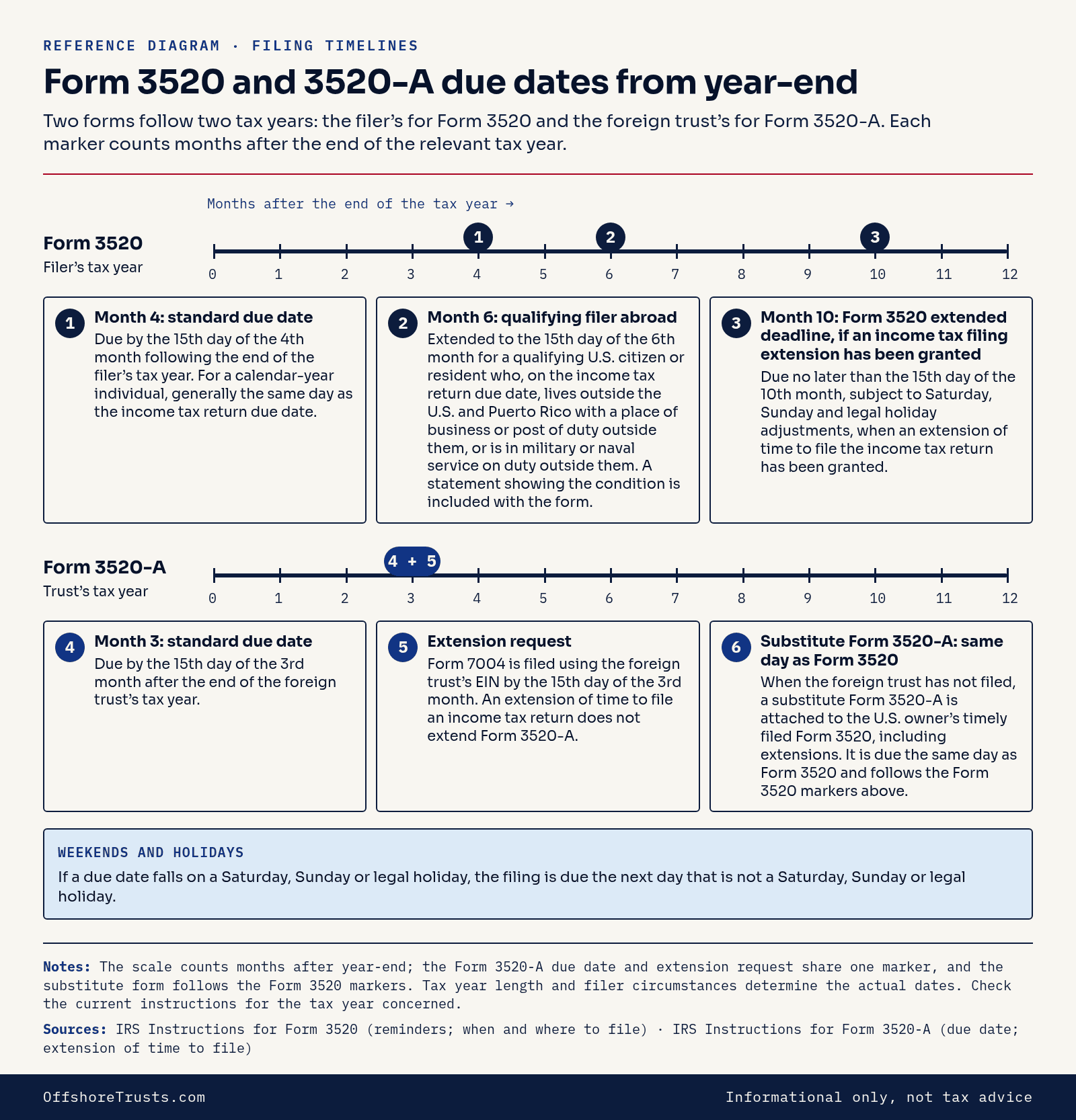
Data table for this infographic
| Form | Tax year used | Due date or condition | Description |
|---|---|---|---|
| Form 3520 | The filer's own tax year | Month 4: standard due date | Due by the 15th day of the 4th month following the end of the filer's tax year. For a calendar-year individual, generally the same day as the income tax return due date. |
| Form 3520 | The filer's own tax year | Month 6: qualifying filer abroad | Extended to the 15th day of the 6th month for a qualifying U.S. citizen or resident who, on the income tax return due date, lives outside the U.S. and Puerto Rico with a place of business or post of duty outside them, or is in military or naval service on duty outside them. A statement showing the condition is included with the form. |
| Form 3520 | The filer's own tax year | Month 10: Form 3520 extended deadline, if an income tax filing extension has been granted | Due no later than the 15th day of the 10th month, subject to Saturday, Sunday and legal holiday adjustments, when an extension of time to file the income tax return has been granted. |
| Form 3520-A | The foreign trust's tax year | Month 3: standard due date | Due by the 15th day of the 3rd month after the end of the foreign trust's tax year. |
| Form 3520-A | The foreign trust's tax year | Extension request | Form 7004 is filed using the foreign trust's EIN by the 15th day of the 3rd month. An extension of time to file an income tax return does not extend Form 3520-A. |
| Substitute Form 3520-A | Follows the filer's Form 3520 timeline | Same day as Form 3520 | When the foreign trust has not filed, a substitute Form 3520-A is attached to the U.S. owner's timely filed Form 3520, including extensions. It is due the same day as Form 3520 and follows the Form 3520 markers above. |
| All forms | The tax year used for each form | Weekends and holidays | If a due date falls on a Saturday, Sunday or legal holiday, the filing is due the next day that is not a Saturday, Sunday or legal holiday. |
| Notes | The filer's or the foreign trust's tax year, depending on the form | Scope | The scale counts months after year-end; the Form 3520-A due date and extension request share one marker, and the substitute form follows the Form 3520 markers. Tax year length and filer circumstances determine the actual dates. The instructions for the tax year concerned govern. |
| Sources | Forms 3520 and 3520-A | Documents | IRS Instructions for Form 3520 (reminders; when and where to file) · IRS Instructions for Form 3520-A (due date; extension of time to file) |
Questions and answers
How does the IRS distinguish a domestic trust from a foreign trust?
A domestic trust meets both the U.S. court supervision test and the U.S. control test. A trust outside that definition is foreign.[1]
Are domestic or foreign status and grantor status the same classification?
No. Domestic or foreign status follows the court and control tests. Grantor status concerns whether trust assets are treated as owned by a person other than the trust under the grantor trust rules.[1]
What does a U.S. owner report about foreign trust income?
A U.S. owner generally reports income attributable to the portion owned under the grantor trust rules. The owner statement contains information about income to report on the U.S. income tax return.[3]
When is Form 3520 due?
Generally, it is due on the 15th day of the fourth month after the taxpayer's tax year ends. Qualifying individuals living and working abroad have a sixth-month date and include a statement with the form, and an income tax return extension can extend the deadline to the tenth month.[1][2]
What is the Form 3520-A calendar?
The foreign trust generally files Form 3520-A by the 15th day of the third month after its tax year ends. A weekend or legal holiday pushes the due date to the next business day. If it does not file, the U.S. owner attaches a substitute form to Form 3520 by that form's due date.[1][2]
Does a foreign trust reporting exception remove Form 8938 or FBAR reporting?
No. The IRS says the specified section 6048 exceptions do not affect Form 8938 or other reporting requirements, including FBAR. Those forms have separate conditions and thresholds.[3]
Related resources
Related glossary terms
- Substitute Form 3520-A: A substitute Form 3520-A is filed by a U.S. owner when a foreign trust fails to file its annual return, and it carries its own timing and statement rules.
- Foreign trust classification: A trust is foreign under Form 3520 when it fails either domestic trust test. The tests ask about U.S. court supervision and control of substantial decisions.
- U.S. person: A U.S. person includes a U.S. citizen or resident alien, a domestic partnership or corporation, a domestic trust, or an estate other than a foreign estate.
Related articles and guides
- BVI trust tax rules and U.S. reporting: The British Virgin Islands Trustee Act describes income tax treatment for trusts and beneficiaries. IRS rules address U.S. person reporting for foreign trusts.
- Cayman Islands trust tax and reporting rules: Cayman Islands rules on exempted trusts and administrative duties, with the IRS reporting rules that apply to U.S. citizens who own or benefit from one.
- Malta trust taxation and U.S. reporting: Malta summarizes trust tax treatment and administrative obligations for a trust with at least one Malta-resident trustee, and IRS forms for U.S. persons.
Related pages
Sources and data notes
- irs.gov, Instructions for Form 3520 (12/2025) | Internal Revenue Service. https://www.irs.gov/instructions/i3520. Retrieved .
- irs.gov, U.S. citizens and residents abroad, Filing requirements | Internal Revenue Service. https://www.irs.gov/individuals/international-taxpayers/us-citizens-and-residents-abroad-filing-requirements. Retrieved .
- irs.gov, Foreign trust reporting requirements and tax consequences | Internal Revenue Service. https://www.irs.gov/businesses/international-businesses/foreign-trust-reporting-requirements-and-tax-consequences. Retrieved .
- govinfo.gov, Federal Register, Volume 89 Issue 90 (Wednesday, May 8, 2024). https://www.govinfo.gov/content/pkg/FR-2024-05-08/html/2024-09434.htm. Retrieved .
- irs.gov, SOI Tax Stats, Foreign trusts metadata | Internal Revenue Service. https://www.irs.gov/statistics/soi-tax-stats-foreign-trusts-metadata. Retrieved .
- floridabar.org, Five Tax Traps for Resident Noncitizens (and Their Attorneys!), The Florida Bar. https://www.floridabar.org/the-florida-bar-journal/five-tax-traps-for-resident-noncitizens-and-their-attorneys/. Retrieved .
- public-inspection.federalregister.gov, Federal Register, Proposed Regulations on Foreign Gifts and Related Foreign Trust Reporting (REG-124851-23), 8 May 2024. https://public-inspection.federalregister.gov/2024-09434.pdf. Retrieved .
Dates in this block record when each source was read for this page.