
Foreign grantor trust beneficiary statement
The Form 3520 instructions describe the Foreign Grantor Trust Beneficiary Statement as a record of trust distributions and information about ownership.
Meaning and location
The Form 3520 instructions describe the Foreign Grantor Trust Beneficiary Statement as a Form 3520-A statement that reports distributions from a foreign trust treated as owned by another person.[1]
It appears on page 5 of Form 3520-A, the annual information return for a foreign trust with at least one U.S. owner. The form also provides information about U.S. beneficiaries and people treated as owners under the grantor trust rules.[2]
The IRS instructions for Form 3520 use the statement in Part III, line 29. A U.S. beneficiary who receives it for a distribution attaches it to Form 3520 and does not complete the remainder of Part III for that distribution.[1]
The foreign trust generally files Form 3520-A and provides the statement to U.S. beneficiaries by the return's due date. If the trust does not file, the instructions assign substitute filing steps to the U.S. owner, including furnishing copies of the statements.[2]
A complete statement identifies the trust and trustee, covers the trust tax year's first and last days, and explains why another person is treated as owning the trust for U.S. tax purposes.[1]
- It identifies the owner as an individual, trust, corporation, or partnership, and describes property distributed or deemed distributed to the U.S. person with its fair market value.[1]
- It states whether the trust has a U.S. agent, including the agent's name, address, and taxpayer identification number when there is one.[1]
- The statement also addresses access to trust records. That access statement is unnecessary if the trust appointed a U.S. agent.[1]
For a complete statement, the Form 3520 instructions say to treat the distribution for income tax purposes as if it came directly from the owner. They give a gift as an example that the beneficiary does not include in gross income.[1]
If any required item is absent, the beneficiary answers No to line 29. The line asks whether a statement was received for the distribution, so the instructions distinguish a complete statement from an incomplete one.[1]
The neighboring Foreign Grantor Trust Owner Statement serves a different reporting role. The Form 3520 instructions refer to owner statements on pages 3 and 4 and beneficiary statements on page 5; the former is attached for the U.S. owner's reporting, while line 29 addresses distributions received by a beneficiary.[1]
The Form 3520 instructions separately describe a Foreign Nongrantor Trust Beneficiary Statement. For that type, line 30 applies; the grantor statement is addressed at line 29. IRS guidance says a beneficiary of either type may receive the corresponding statement, which contains information about distribution taxability, and Form 3520 has distribution reporting rules even when no statement arrives.[7]
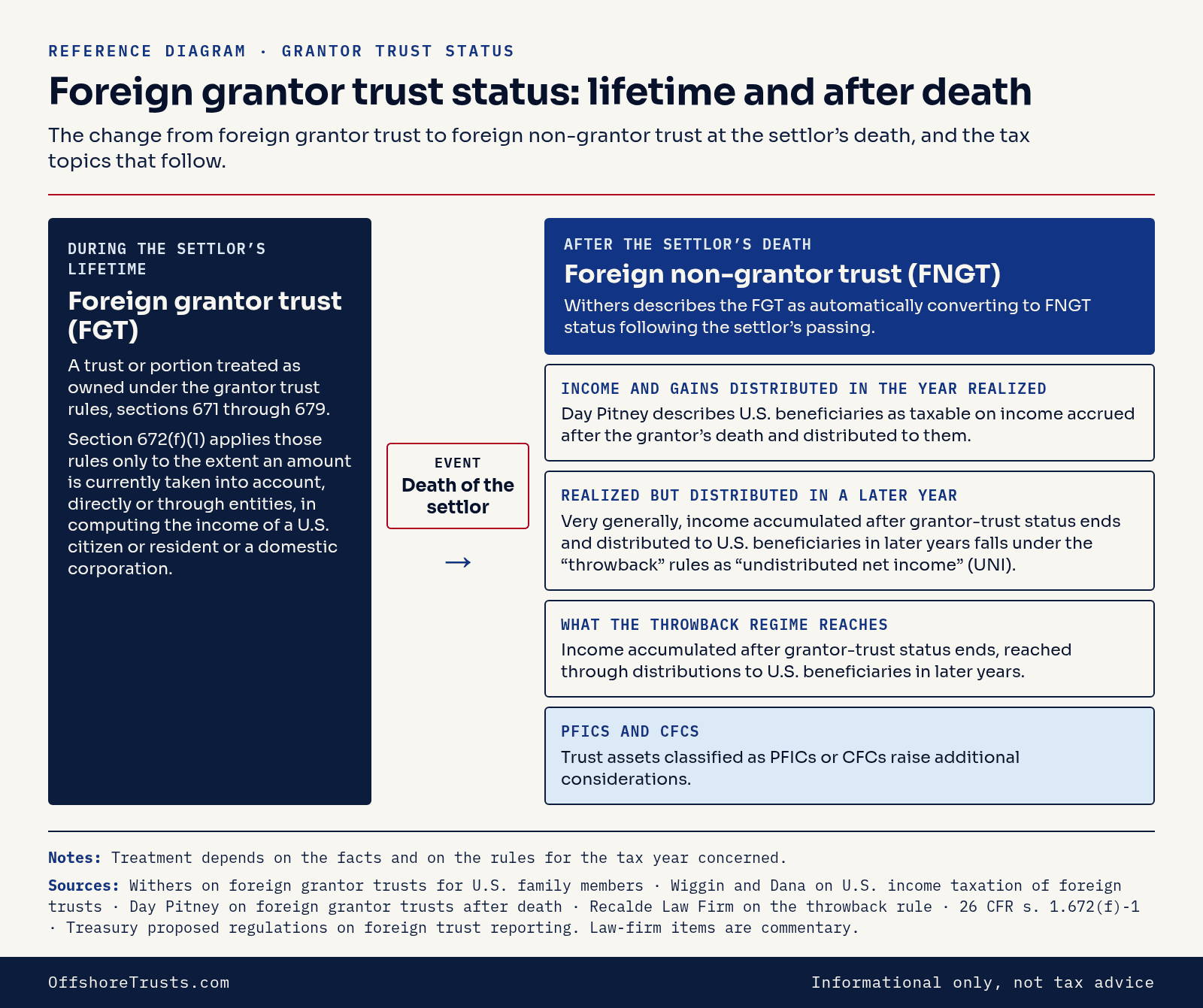
Data table for this infographic
| Stage or topic | Status or event | Description | Tax treatment or reporting |
|---|---|---|---|
| During the settlor's lifetime | Foreign grantor trust (FGT) | A trust or portion treated as owned under the grantor trust rules, sections 671 through 679. | Section 672(f)(1) applies those rules only to the extent an amount is currently taken into account, directly or through entities, in computing the income of a U.S. citizen or resident or a domestic corporation. |
| Event | Death of the settlor | Grantor trust status generally ends at the settlor's death. | |
| After the settlor's death | Foreign non-grantor trust (FNGT) | The trust generally becomes a foreign non-grantor trust after the settlor's death. | |
| What the throwback regime reaches | Income accumulated after grantor-trust status ends, reached through distributions to U.S. beneficiaries in later years. | ||
| Notes | Treatment depends on the facts and on the rules for the tax year concerned. | ||
Income and gains distributed in the year realized: Distributions to U.S. beneficiaries of income accrued after the grantor's death are generally included in their income under the rules for foreign non-grantor trusts.
Realized but distributed in a later year: Very generally, income accumulated after grantor-trust status ends and distributed to U.S. beneficiaries in later years falls under the "throwback" rules as "undistributed net income" (UNI).
PFICs and CFCs: Trust assets classified as PFICs or CFCs raise additional considerations.
Questions and answers
Where does the statement appear?
It is page 5 of Form 3520-A, the annual information return for a foreign trust with at least one U.S. owner. The Form 3520 instructions address it at Part III, line 29.[2]
What information does a complete statement include?
It covers the trust tax year, explains why another person is treated as owner, identifies that owner, and describes distributions and their value. It also addresses a U.S. agent and trust record access.[1]
How does the statement affect reporting for a distribution?
A beneficiary who receives the statement for a distribution attaches it to Form 3520 and does not complete the rest of Part III for that distribution. If the statement is complete, the distribution is treated for income tax purposes as coming directly from the owner.[1]
What if a required item is missing?
The Form 3520 instructions say to answer No at line 29 if any required item is missing.
How does it differ from a nongrantor trust beneficiary statement?
The instructions name a separate Foreign Nongrantor Trust Beneficiary Statement and address it at line 30. IRS guidance describes the grantor and nongrantor statements as corresponding statements for beneficiaries of the respective trust types.[1]
Related terms
- Foreign grantor trust owner statement: The Instructions for Form 3520-A identify the Foreign Grantor Trust Owner Statement as pages 3 and 4 of the foreign trust's annual information return.
- Substitute Form 3520-A: A substitute Form 3520-A is filed by a U.S. owner when a foreign trust fails to file its annual return, and it carries its own timing and statement rules.
- U.S. beneficiary of a foreign trust: The Form 3520 instructions explain who is a U.S. beneficiary of a foreign trust and how that status relates to distributions and ownership, plus reporting.
- Nongrantor trust: A nongrantor trust is taxable to the extent its assets are not treated as owned by another person. Partial treatment and beneficiary reporting both apply.
Related guides and articles
- Foreign trust forms and the accounts behind them: Forms 3520 and 3520-A cover transfers to a foreign trust, its ownership and its distributions. Bank accounts behind a trust add separate FBAR and 8938 rules.
- Tax planning and compliance for foreign trusts: U.S. rules classify trusts and assign tax and reporting duties to U.S. citizens connected with foreign trusts, including forms, filing calendars and records.
- Section 6048 reporting for certain foreign trusts: Section 6048 foreign trust reporting for U.S. citizens, including definitions and reportable events, as well as ownership and distributions and the IRS forms.
Related pages
Sources and data notes
- Internal Revenue Service, Instructions for Form 3520. https://www.irs.gov/instructions/i3520. Retrieved .
- Internal Revenue Service, Instructions for Form 3520-A. https://www.irs.gov/instructions/i3520a. Retrieved .
- Internal Revenue Service, 26 CFR 301.7701-7 Trusts, domestic and foreign. https://ecfr.io/Title-26/Section-301.7701-7. Retrieved .
- Internal Revenue Service, 26 CFR 301.7701-4 Trusts. https://www.ecfr.gov/current/title-26/section-301.7701-4. Retrieved .
- Internal Revenue Service, 26 U.S.C. 679. https://uscode.house.gov/us/usc/119-118/t26/s679/. Retrieved .
- Internal Revenue Service, 26 U.S.C. 6048. https://uscode.house.gov/us/usc/119-118/t26/s6048/. Retrieved .
- Internal Revenue Service, Foreign trust reporting requirements and tax consequences. https://www.irs.gov/businesses/international-businesses/foreign-trust-reporting-requirements-and-tax-consequences. Retrieved .
Dates in this block record when each source was read for this page.