
Foreign trust classification
The IRS instructions for Forms 3520 and 3520-A describe a foreign trust as a trust outside the domestic trust definition. That classification connects to rules for trust ownership, transfers, distributions, and information reporting.
Definition and classification tests
The IRS instructions for Form 3520 define a foreign trust as any trust that does not meet the two tests for a domestic trust. The trust is domestic only when a U.S. court can exercise primary supervision over its administration and one or more U.S. persons can control all substantial decisions.[1]
The regulation says the trust instrument and applicable law determine whether each test is met. A trust qualifies as a U.S. person for Internal Revenue Code purposes on any day when it meets both tests, so the classification can depend on the trust's circumstances on that day.[3]
For the court test, one safe harbor applies when the instrument does not direct administration outside the United States, administration in fact occurs exclusively within the United States, and no specified automatic migration provision applies. The control test asks whether U.S. persons have power to make all substantial decisions without another person's veto.[3]
Decisions and neighboring terms
Substantial decisions are those authorized or required by the trust instrument and applicable law that are not ministerial. The regulation lists decisions such as the timing or amount of distributions, choosing beneficiaries, ending the trust, and investment decisions.[3]
Control considers everyone with authority over a substantial decision, not only the fiduciaries. The regulation also includes a limited rule for an investment adviser: when a U.S. person can end the adviser's decision-making power at will, the adviser's investment decisions count as controlled by that U.S. person.[3]
Foreign or domestic classification is separate from grantor or nongrantor status. The Form 3520 instructions define a grantor trust as one whose assets are treated as owned by someone other than the trust, and a nongrantor trust as one whose assets are not treated that way. Either label can apply to only part of a trust's assets.[1]
For a U.S. person, the classification matters to reporting categories. Form 3520 covers certain transactions with foreign trusts, ownership under the grantor trust rules, and distributions; the instructions say Form 3520-A may also be required for a U.S. owner.[1]
A change in classification can also appear in reporting instructions. Form 3520 identifies the gross value of trust assets at the time a domestic trust becomes foreign when a U.S. citizen or resident previously transferred property and is alive at that time.[1]
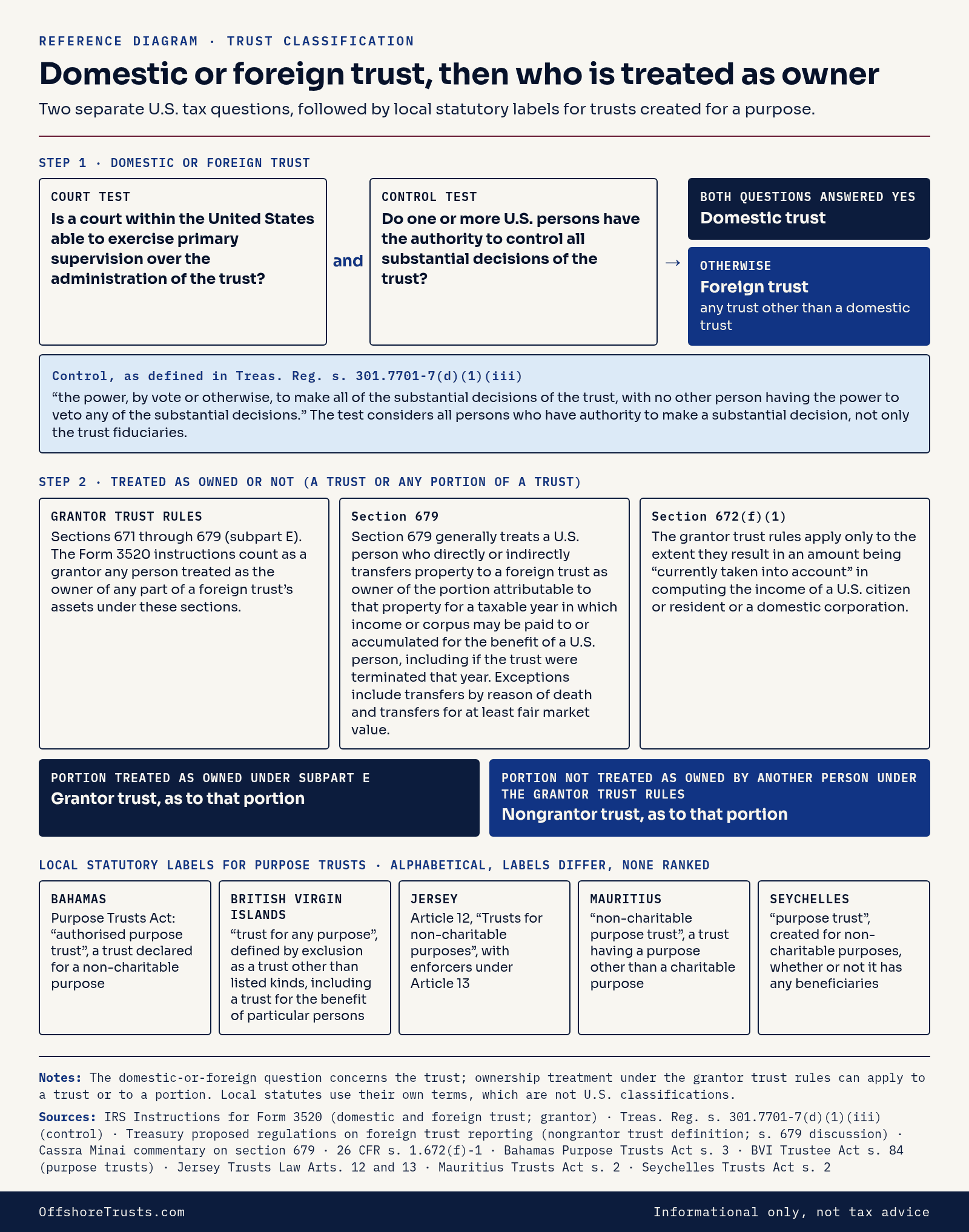
Data table for this infographic
| Group | Question or label | Description or rule | Result or source |
|---|---|---|---|
| Reference diagram · Trust classification | Domestic or foreign trust, then who is treated as owner | Two separate U.S. tax questions, followed by local statutory labels for trusts created for a purpose. | |
| Step 1 · Domestic or foreign trust | Court test | Is a court within the United States able to exercise primary supervision over the administration of the trust? | |
| Step 1 · Domestic or foreign trust | Control test | Do one or more U.S. persons have the authority to control all substantial decisions of the trust? | |
| Step 1 · Domestic or foreign trust | Both questions answered yes | Domestic trust | |
| Step 1 · Domestic or foreign trust | Otherwise | Foreign trust, any trust other than a domestic trust | |
| Control, as defined in Treas. Reg. s. 301.7701-7(d)(1)(iii) | Control | "the power, by vote or otherwise, to make all of the substantial decisions of the trust, with no other person having the power to veto any of the substantial decisions." The test considers all persons who have authority to make a substantial decision, not only the trust fiduciaries. | Treas. Reg. s. 301.7701-7(d)(1)(iii) |
| Step 2 · Treated as owned or not (a trust or any portion of a trust) | Grantor trust rules | Sections 671 through 679 (subpart E). The Form 3520 instructions count as a grantor any person treated as the owner of any part of a foreign trust's assets under these sections. | |
| Step 2 · Treated as owned or not (a trust or any portion of a trust) | Section 679 | Section 679 generally treats a U.S. person who directly or indirectly transfers property to a foreign trust as owner of the portion attributable to that property for a taxable year in which income or corpus may be paid to or accumulated for the benefit of a U.S. person, including if the trust were terminated that year. Exceptions include transfers by reason of death and transfers for at least fair market value. | |
| Step 2 · Treated as owned or not (a trust or any portion of a trust) | Section 672(f)(1) | The grantor trust rules apply only to the extent they result in an amount being "currently taken into account" in computing the income of a U.S. citizen or resident or a domestic corporation. | |
| Step 2 · Treated as owned or not (a trust or any portion of a trust) | Portion treated as owned under subpart E | Grantor trust, as to that portion | |
| Step 2 · Treated as owned or not (a trust or any portion of a trust) | Portion not treated as owned by another person under the grantor trust rules | Nongrantor trust, as to that portion | |
| Local statutory labels for purpose trusts · alphabetical, labels differ, none ranked | Bahamas | Purpose Trusts Act: "authorised purpose trust", a trust declared for a non-charitable purpose | statute |
| Local statutory labels for purpose trusts · alphabetical, labels differ, none ranked | British Virgin Islands | "trust for any purpose", defined by exclusion as a trust other than listed kinds, including a trust for the benefit of particular persons | statute |
| Local statutory labels for purpose trusts · alphabetical, labels differ, none ranked | Jersey | Article 12, "Trusts for non-charitable purposes", with enforcers under Article 13 | statute |
| Local statutory labels for purpose trusts · alphabetical, labels differ, none ranked | Mauritius | "non-charitable purpose trust", a trust having a purpose other than a charitable purpose | statute |
| Local statutory labels for purpose trusts · alphabetical, labels differ, none ranked | Seychelles | "purpose trust", created for non-charitable purposes, whether or not it has any beneficiaries | statute |
| Notes | Commentary and statute | The domestic-or-foreign question concerns the trust; ownership treatment under the grantor trust rules can apply to a trust or to a portion. Local statutes use their own terms, which are not U.S. classifications. | commentary |
| Sources | U.S. sources | IRS Instructions for Form 3520 (domestic and foreign trust; grantor) · Treas. Reg. s. 301.7701-7(d)(1)(iii) (control) · Treasury proposed regulations on foreign trust reporting (nongrantor trust definition; s. 679 discussion) · Cassra Minai commentary on section 679 · 26 CFR s. 1.672(f)-1 | |
| Sources | Local statute sources | Bahamas Purpose Trusts Act s. 3 · BVI Trustee Act s. 84 (purpose trusts) · Jersey Trusts Law Arts. 12 and 13 · Mauritius Trusts Act s. 2 · Seychelles Trusts Act s. 2 | |
Related reading
Foreign trust explains how the court and control tests determine whether a trust is foreign. Foreign grantor trust connects classification to grantor trust ownership. Transfer to a foreign trust covers transfers involving a foreign trust. Distribution from a foreign trust covers distributions, another reporting category associated with foreign trusts.
Questions and answers
What makes a trust foreign for U.S. tax purposes?
Under the IRS instructions, a foreign trust is one that is not domestic. Domestic status requires both U.S. court supervision over administration and U.S. person control of all substantial decisions.[1]
Does administration in the United States alone make a trust domestic?
No. The court test and control test both have to be met. The regulation's safe harbor for the court test includes exclusive U.S. administration, but it does not replace the separate control test.[3]
Which decisions count as substantial?
The regulation includes nonministerial decisions authorized or required by the trust terms and applicable law. Examples include distribution decisions, beneficiary selection, termination, and investment decisions.[3]
Does foreign status determine whether a trust is a grantor trust?
No. Foreign or domestic status uses the court and control tests, while grantor status concerns whether another person is treated as owning trust assets. The grantor or nongrantor treatment may apply to only a portion of the assets.[1]
Which IRS forms appear in the foreign trust instructions?
The Form 3520 instructions identify reporting for certain foreign trust transactions, ownership under grantor trust rules, and distributions. They state that a U.S. owner may also need to complete a substitute Form 3520-A.[1]
Related terms
- Control test: The control test is part of the IRS rules for classifying trusts as domestic or foreign. It describes whose authority over substantial decisions counts.
- Substantial decisions: Substantial decisions under a trust include nonministerial choices about distributions, beneficiaries, income, principal, trustee changes, and investments.
- Domestic trust: The IRS defines a domestic trust through its court test and control test, and the term appears in U.S. foreign trust reporting rules for U.S. citizens.
- Court test: The IRS court test asks whether a U.S. court can supervise trust administration. It works with the control test to determine whether a trust is domestic.
Related guides and articles
- The court and control tests for foreign trusts: The court test and the control test classify a trust as domestic or foreign, and foreign trust status connects to U.S. reporting rules for U.S. citizens.
- Tax planning and compliance for foreign trusts: U.S. rules classify trusts and assign tax and reporting duties to U.S. citizens connected with foreign trusts, including forms, filing calendars and records.
- Grantor and nongrantor trust taxation: U.S. income tax rules distinguish grantor and nongrantor trusts for U.S. citizens. Sections 671 through 679 may assign ownership of all or part of a trust.
Related pages
Sources and data notes
- Internal Revenue Service, Instructions for Form 3520. https://www.irs.gov/instructions/i3520. Retrieved .
- Internal Revenue Service, Instructions for Form 3520-A. https://www.irs.gov/instructions/i3520a. Retrieved .
- Internal Revenue Service, 26 CFR 301.7701-7 Trusts, domestic and foreign. https://ecfr.io/Title-26/Section-301.7701-7. Retrieved .
- Internal Revenue Service, 26 CFR 301.7701-4 Trusts. https://www.ecfr.gov/current/title-26/section-301.7701-4. Retrieved .
- Internal Revenue Service, 26 U.S.C. 679. https://uscode.house.gov/us/usc/119-118/t26/s679/. Retrieved .
- Internal Revenue Service, 26 U.S.C. 6048. https://uscode.house.gov/us/usc/119-118/t26/s6048/. Retrieved .
- Internal Revenue Service, Foreign trust reporting requirements and tax consequences. https://www.irs.gov/businesses/international-businesses/foreign-trust-reporting-requirements-and-tax-consequences. Retrieved .
- irs.gov, 8.11.5 International Penalties | Internal Revenue Service. https://www.irs.gov/irm/part8/irm_08-011-005. Retrieved .
Dates in this block record when each source was read for this page.