
Distribution from a foreign trust
The Form 3520 instructions describe a distribution from a foreign trust for section 6048(c) reporting.
Meaning in Form 3520 reporting
A distribution from a foreign trust is a gratuitous transfer of money or other property, whether or not the trust has assets treated as owned by a grantor. For Form 3520 reporting, the definition applies even when the recipient is not named as a beneficiary, and includes trust corpus and certain gifts or bequests.[1]
The term appears in Part III of Form 3520, which covers distributions to a U.S. person during the tax year. A U.S. person, including a U.S. owner, and an executor of a U.S. person's estate are within the filing instructions when they received a distribution during that year.[1]
For line 24, the instructions call for cash or the fair market value of other property received actually or constructively, directly or indirectly. The amount is reported whether or not it is taxable, subject to the separate treatment for a loan or uncompensated use of trust property described below.[1]
Loans, property use, and taxable amounts
These reporting categories do not by themselves settle taxability. A beneficiary of a foreign nongrantor trust generally reports the beneficiary's share of distributable net income, and the beneficiary statement provides information about taxability. The Form 3520 instructions also distinguish reporting a loan or property use from treating it as a taxable distribution under section 643(i) in specified circumstances.[7]
For non-grantor trust distributions, Part III includes calculations involving undistributed net income and accumulation distributions. The instructions describe undistributed net income as trust income accumulated and not distributed, and use weighted undistributed net income in calculating an applicable number of years.[1]
How these terms relate
A foreign trust means any trust other than a domestic trust. The instructions define a domestic trust by two conditions: a U.S. court can exercise primary supervision over administration, and one or more U.S. persons control all substantial decisions.[1]
A U.S. beneficiary generally includes a U.S. person who could benefit directly or indirectly at any time, even if not designated in the trust instrument or eligible for a current-year distribution. A U.S. owner is a person treated as owning trust assets under the grantor trust rules. These terms help explain who may have reporting responsibilities when a foreign trust makes a distribution.[1]
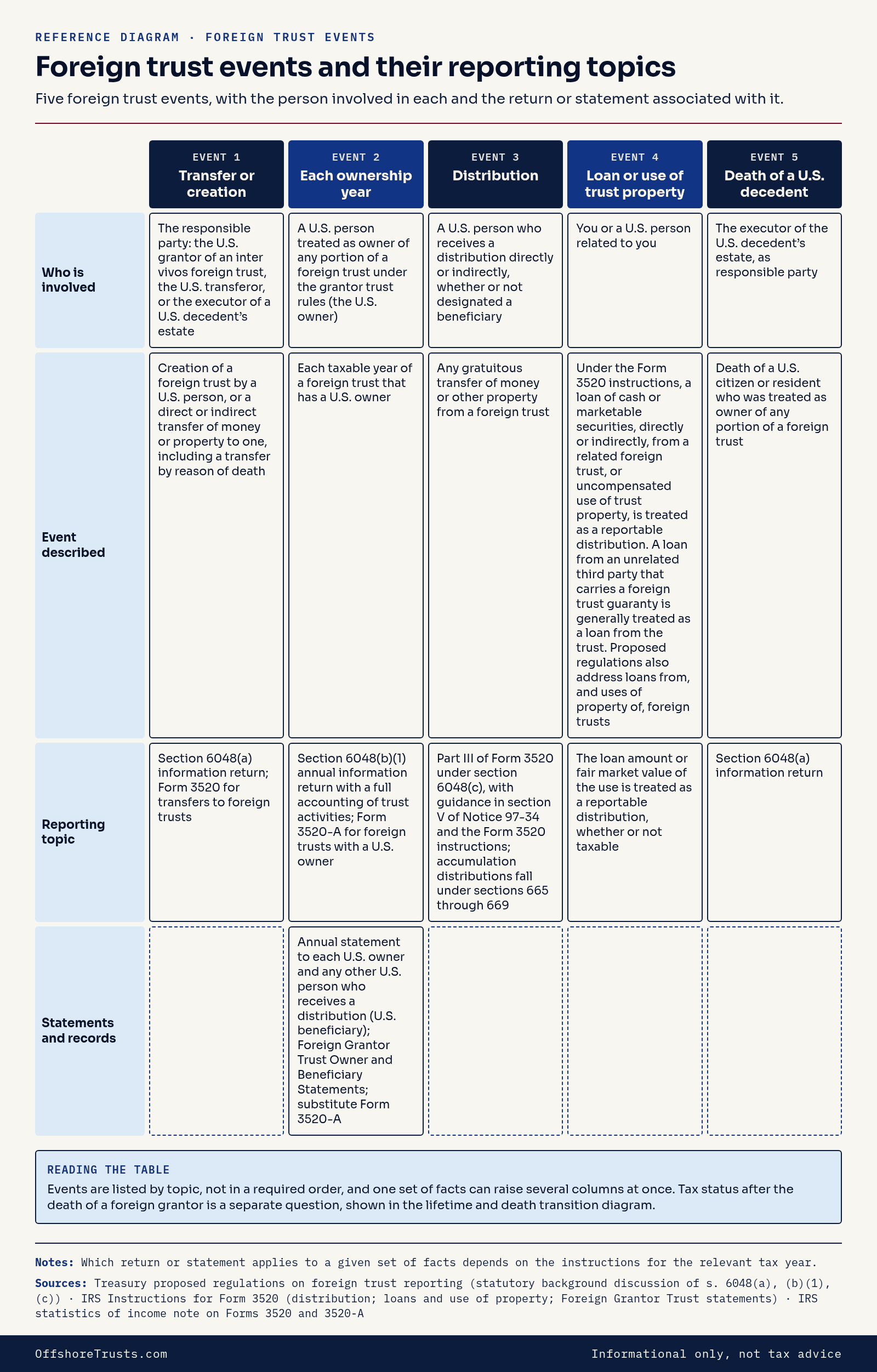
Data table for this infographic
| Event group | Event described | Who is involved | Reporting topic | Statements and records |
|---|---|---|---|---|
| Transfer or creation | Creation of a foreign trust by a U.S. person, or a direct or indirect transfer of money or property to one, including a transfer by reason of death | The responsible party: the U.S. grantor of an inter vivos foreign trust, the U.S. transferor, or the executor of a U.S. decedent's estate | Section 6048(a) information return; Form 3520 for transfers to foreign trusts | Not covered |
| Each ownership year | Each taxable year of a foreign trust that has a U.S. owner | A U.S. person treated as owner of any portion of a foreign trust under the grantor trust rules (the U.S. owner) | Section 6048(b)(1) annual information return with a full accounting of trust activities; Form 3520-A for foreign trusts with a U.S. owner | Annual statement to each U.S. owner and any other U.S. person who receives a distribution (U.S. beneficiary); Foreign Grantor Trust Owner and Beneficiary Statements; substitute Form 3520-A |
| Distribution | Any gratuitous transfer of money or other property from a foreign trust | A U.S. person who receives a distribution directly or indirectly, whether or not designated a beneficiary | Part III of Form 3520 under section 6048(c), with guidance in section V of Notice 97-34 and the Form 3520 instructions; accumulation distributions fall under sections 665 through 669 | Not covered |
| Loan or use of trust property | Under the Form 3520 instructions, a loan of cash or marketable securities, directly or indirectly, from a related foreign trust, or uncompensated use of trust property, is treated as a reportable distribution. A loan from an unrelated third party that carries a foreign trust guaranty is generally treated as a loan from the trust. Proposed regulations also address loans from, and uses of property of, foreign trusts. | You or a U.S. person related to you | The loan amount or fair market value of the use is treated as a reportable distribution, whether or not taxable | Not covered |
| Death of a U.S. decedent | Death of a U.S. citizen or resident who was treated as owner of any portion of a foreign trust | The executor of the U.S. decedent's estate, as responsible party | Section 6048(a) information return | Not covered |
| Any event | Any of the events listed in this table | Any of the parties listed in this table | Which return or statement applies to a given set of facts depends on the instructions for the relevant tax year | Not covered |
Questions and answers
Does every distribution count as taxable income?
The Form 3520 instructions say to report the amount received on line 24 whether or not it is taxable. For a beneficiary receiving from a foreign nongrantor trust, the IRS overview says the beneficiary generally reports a share of distributable net income.[1][7]
Can someone who is not named as a beneficiary receive a reportable distribution?
Yes. The definition covers a gratuitous transfer to a recipient regardless of whether the trust terms designate that person as a beneficiary.[1]
What does an indirect distribution look like?
If a partnership receives a foreign trust distribution, a partner reports the partner's allocable share as an indirect distribution.[1]
What do undistributed net income and accumulation distribution mean here?
Weighted undistributed net income reflects accumulated income that remains undistributed, weighted by the years it accumulated.[1]
Related terms
- Accumulation distribution: The Form 3520 instructions use accumulation distribution for certain distributions from foreign trusts and explain how U.S. beneficiaries report them.
- U.S. beneficiary of a foreign trust: The Form 3520 instructions explain who is a U.S. beneficiary of a foreign trust and how that status relates to distributions and ownership, plus reporting.
- Nongrantor trust: A nongrantor trust is taxable to the extent its assets are not treated as owned by another person. Partial treatment and beneficiary reporting both apply.
- Uncompensated use of trust property: Uncompensated use of foreign trust property by a U.S. person or a related U.S. person is treated as a distribution at fair market value and is reportable.
Related guides and articles
- Section 6048 reporting for certain foreign trusts: Section 6048 foreign trust reporting for U.S. citizens, including definitions and reportable events, as well as ownership and distributions and the IRS forms.
- Foreign trust distributions: DNI and UNI: Foreign trust distributions can carry current distributable net income or accumulated undistributed net income, and each has its own U.S. tax treatment.
- Tax planning and compliance for foreign trusts: U.S. rules classify trusts and assign tax and reporting duties to U.S. citizens connected with foreign trusts, including forms, filing calendars and records.
Related pages
Sources and data notes
- Internal Revenue Service, Instructions for Form 3520. https://www.irs.gov/instructions/i3520. Retrieved .
- Internal Revenue Service, Instructions for Form 3520-A. https://www.irs.gov/instructions/i3520a. Retrieved .
- Internal Revenue Service, 26 CFR 301.7701-7 Trusts, domestic and foreign. https://ecfr.io/Title-26/Section-301.7701-7. Retrieved .
- Internal Revenue Service, 26 CFR 301.7701-4 Trusts. https://www.ecfr.gov/current/title-26/section-301.7701-4. Retrieved .
- Internal Revenue Service, 26 U.S.C. 679. https://uscode.house.gov/us/usc/119-118/t26/s679/. Retrieved .
- Internal Revenue Service, 26 U.S.C. 6048. https://uscode.house.gov/us/usc/119-118/t26/s6048/. Retrieved .
- Internal Revenue Service, Foreign trust reporting requirements and tax consequences. https://www.irs.gov/businesses/international-businesses/foreign-trust-reporting-requirements-and-tax-consequences. Retrieved .
Dates in this block record when each source was read for this page.