
Grantor
The instructions for Form 3520 describe a grantor as a person who creates a trust, transfers property to it without full value in return, or is treated as an owner under specified rules. For a U.S. citizen, the term appears in foreign trust reporting and ownership rules.
Meaning in the Form 3520 instructions
The Form 3520 instructions define a grantor to include a person who creates a trust or directly or indirectly makes a gratuitous transfer of cash or other property to it. They also include a person treated as owning part of a foreign trust under sections 671 through 679, with section 678 excluded from that part of the definition.[1]
The instructions use the term more broadly than simply the person who first establishes a trust. A gratuitous transfer to a trust can qualify even if the transfer is not a gift for gift tax purposes. The instructions separately define a grantor trust by ownership: it is a trust to the extent that a person other than the trust is treated as owning its assets. A trust can therefore have grantor and nongrantor portions.[1]
When a partnership or corporation makes a gratuitous transfer, its partners or shareholders are generally treated as grantors. The stated exception is a transfer made for a business purpose of that partnership or corporation.[1]
For a transfer from one trust to another, the grantor of the transferring trust is generally treated as grantor of the receiving trust. If someone holding a general power of appointment over the first trust exercises it in favor of another trust, that person is treated as the grantor of the receiving trust, even when the first trust's grantor is treated as its owner.[1]
Connection to ownership and reporting
The term grantor is related to, but distinct from, owner. The Form 3520 instructions define an owner as the person treated as owning foreign trust assets under sections 671 through 679. Under section 679, a U.S. person can be treated as owner of the portion of a foreign trust attributable to property that person transferred to it if a U.S. beneficiary exists for that tax year, subject to statutory exceptions.[1][5]
Section 679 excludes transfers by reason of death and transfers exchanged for consideration at least equal to fair market value from its general transferor-owner rule. It also limits how certain obligations are counted when assessing fair market value for specified persons. These conditions mean that being a grantor under the Form 3520 definition does not alone establish ownership under section 679.[5]
For a U.S. citizen treated as owner of a foreign trust, section 6048 calls for information about the trust and responsibility to ensure the trust files an annual return and provides required information to owners and recipients of distributions. A U.S. owner is taxed under the grantor trust rules on income attributable to the portion of the foreign trust treated as owned. Form 3520 reporting also applies when a U.S. owner receives a distribution from a foreign grantor trust.[6][7]
How these terms relate
A transferor is described by the act of transferring property, while grantor can also include a trust creator or a person treated as an owner. In the specific rule of section 679, the United States person who transfers property is treated as owner of the portion attributable to that property only when the stated U.S. beneficiary condition is met and no listed exception applies. The concepts overlap, but the labels are not interchangeable in every rule.[5]
A beneficiary is another related term. Section 679's ownership rule turns in part on whether a U.S. beneficiary exists, while section 6048 addresses information provided to U.S. persons treated as owners and to those receiving distributions. Beneficiary, grantor, transferor, and owner can therefore describe different roles under these provisions.[5][6]
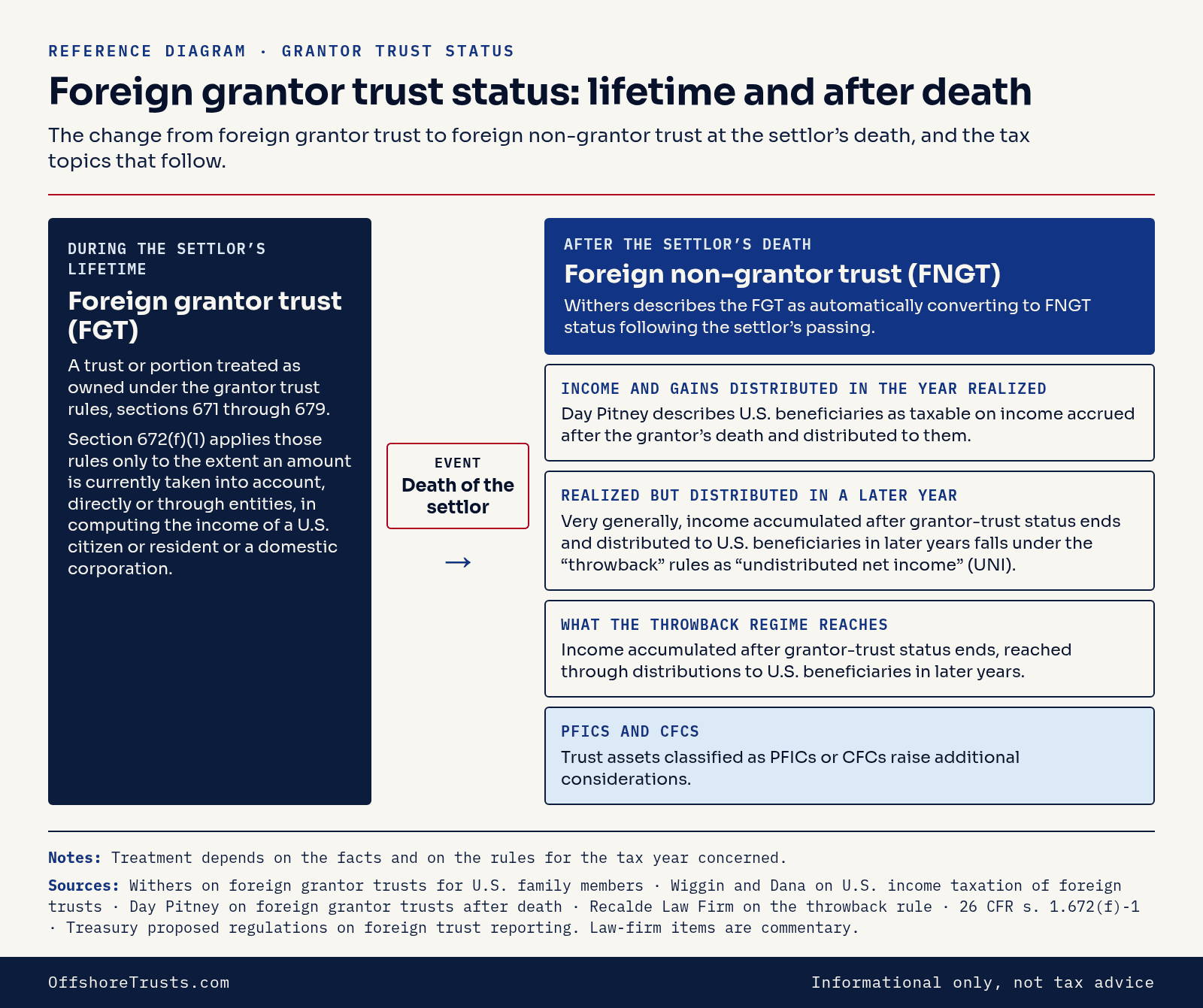
Data table for this infographic
| Stage or topic | Status or event | Description | Tax treatment or reporting |
|---|---|---|---|
| During the settlor's lifetime | Foreign grantor trust (FGT) | A trust or portion treated as owned under the grantor trust rules, sections 671 through 679. | Section 672(f)(1) applies those rules only to the extent an amount is currently taken into account, directly or through entities, in computing the income of a U.S. citizen or resident or a domestic corporation. |
| Event | Death of the settlor | Grantor trust status generally ends at the settlor's death. | |
| After the settlor's death | Foreign non-grantor trust (FNGT) | The trust generally becomes a foreign non-grantor trust after the settlor's death. | |
| What the throwback regime reaches | Income accumulated after grantor-trust status ends, reached through distributions to U.S. beneficiaries in later years. | ||
| Notes | Treatment depends on the facts and on the rules for the tax year concerned. | ||
Income and gains distributed in the year realized: Distributions to U.S. beneficiaries of income accrued after the grantor's death are generally included in their income under the rules for foreign non-grantor trusts.
Realized but distributed in a later year: Very generally, income accumulated after grantor-trust status ends and distributed to U.S. beneficiaries in later years falls under the "throwback" rules as "undistributed net income" (UNI).
PFICs and CFCs: Trust assets classified as PFICs or CFCs raise additional considerations.
Questions and answers
Does grantor mean only the person who created the trust?
No. The Form 3520 instructions also include people who make gratuitous transfers and people treated as owners of foreign trust assets under specified rules. Separate attribution rules apply to transfers made by entities or from one trust to another.[1]
Are grantor and owner interchangeable terms?
No. The instructions define grantor to include creators, transferors, and certain owners, while owner refers to a person treated as owning foreign trust assets under sections 671 through 679. The definition of grantor excludes section 678 from its ownership reference.[1]
When does section 679 treat a transferor as an owner?
The rule generally treats a U.S. person who directly or indirectly transfers property to a foreign trust as owner of the portion attributable to that property when a U.S. beneficiary exists for that year. The statute states exceptions for transfers due to death and transfers for at least fair market value consideration.[5]
Can a business entity's transfer make its owners grantors?
The Form 3520 instructions generally treat partners or shareholders as grantors when a partnership or corporation makes a gratuitous transfer to a trust. The instructions except a transfer made for the entity's business purpose.[1]
What reporting is linked to U.S. owner status?
Section 6048 requires information about a foreign trust from a U.S. person treated as owner and addresses the trust's annual return and information to owners and distribution recipients. A U.S. owner is taxed under the grantor trust rules on income attributable to the portion of the trust treated as owned.[6][7]
Related terms
- Transfer to a foreign trust: Form 3520 covers direct and indirect transfers of money or property to a foreign trust, including gratuitous transfers, alongside the U.S. ownership rules.
- Responsible party: The Instructions for Form 3520 define the responsible party for specified events involving a foreign trust. The role differs from an owner or U.S. agent.
- U.S. owner of a foreign trust: The Form 3520 instructions define a U.S. owner as a person treated as owning trust assets under grantor trust rules. Ownership can apply to part of a trust.
- Section 679: Section 679 addresses certain transfers by U.S. persons to foreign trusts. It treats some property transfers as ownership when the trust has a U.S. beneficiary.
Related guides and articles
- Section 6048 reporting for certain foreign trusts: Section 6048 foreign trust reporting for U.S. citizens, including definitions and reportable events, as well as ownership and distributions and the IRS forms.
- Section 679 and foreign trusts with U.S. beneficiaries: Section 679 covers ownership treatment, U.S. beneficiaries, transfer exceptions and related reporting rules for foreign trusts connected to U.S. citizens.
- Grantor and nongrantor trust taxation: U.S. income tax rules distinguish grantor and nongrantor trusts for U.S. citizens. Sections 671 through 679 may assign ownership of all or part of a trust.
Related pages
Sources and data notes
- Internal Revenue Service, Instructions for Form 3520. https://www.irs.gov/instructions/i3520. Retrieved .
- Internal Revenue Service, Instructions for Form 3520-A. https://www.irs.gov/instructions/i3520a. Retrieved .
- Internal Revenue Service, 26 CFR 301.7701-7 Trusts, domestic and foreign. https://ecfr.io/Title-26/Section-301.7701-7. Retrieved .
- Internal Revenue Service, 26 CFR 301.7701-4 Trusts. https://www.ecfr.gov/current/title-26/section-301.7701-4. Retrieved .
- Internal Revenue Service, 26 U.S.C. 679. https://uscode.house.gov/us/usc/119-118/t26/s679/. Retrieved .
- Internal Revenue Service, 26 U.S.C. 6048. https://uscode.house.gov/us/usc/119-118/t26/s6048/. Retrieved .
- Internal Revenue Service, Foreign trust reporting requirements and tax consequences. https://www.irs.gov/businesses/international-businesses/foreign-trust-reporting-requirements-and-tax-consequences. Retrieved .
Dates in this block record when each source was read for this page.