
Form 3520-A: annual information return of a foreign trust
Form 3520-A is the annual information return of a foreign trust with a U.S. owner, covering ownership, annual statements, attachments, related forms and timing.
What Form 3520-A reports
Form 3520-A provides annual information about a foreign trust that has at least one U.S. owner. The IRS describes its scope as information about the trust, its U.S. beneficiaries, and U.S. persons treated as owning any part of it under sections 671 through 679.[2]
The instructions place the filing requirement on the foreign trust and responsibility for ensuring filing and delivery of annual statements on each U.S. owner. Citizenship falls within the instructions' definition of a U.S. person.[2]
How the instructions define ownership and distributions
Ownership means treatment as owning foreign trust assets under the grantor trust rules. A trust can have grantor trust status for only part of its assets, so the definition does not require another person to own the entire trust.[2]
The grantor definition includes someone who establishes a trust or makes a direct or indirect gratuitous contribution of cash or other property. The instructions also include persons treated as owners under sections 671 through 679, with section 678 excluded from that part of the definition.[2]
A U.S. beneficiary generally includes a U.S. person who could benefit directly or indirectly at any time. That definition can apply without a named beneficiary designation and without an entitlement to receive a distribution during the reporting period.[2]
For distribution reporting under section 6048(c), the definition covers gratuitous transfers of money or property, including trust principal. It also includes constructive transfers, such as charges a beneficiary makes on a credit card that the foreign trust pays.[2]
What the main return asks for
The main return collects identifying information, an income statement, and a balance sheet. The instructions require English throughout the submission and amounts expressed in U.S. currency.[2]
Part I identifies the foreign trust using an employer identification number, or EIN. Individuals are identified using Social Security numbers or individual taxpayer identification numbers, while the instructions assign EINs to trusts and other listed entities.[2]
Part II includes income from both U.S. and foreign sources, measured under U.S. income tax principles. When a trust receives Schedule K-1 information from a flow-through entity, the instructions direct the reported income categories to the corresponding Form 3520-A lines.[2]
Separate instructions address deductible administration fees and other expenses. Multiple items reported as other income or other expenses require an attached statement identifying their types and amounts.[2]
Part III includes every trust asset and liability, including amounts attributable to portions without a U.S. owner. The instructions call for fair market values and do not require reconciliation of differences between book and tax bases for this part.[2]
Which attachments and statements accompany the return
The required attachments depend partly on whether the trust has appointed a U.S. agent. Without that appointment, the instructions request a summary of trust terms, including oral understandings, copies of trust documents and revisions, and an organizational chart showing ownership percentages.[2]
If those documents accompanied a return filed within the preceding three years, only relevant updates are requested. For a trust with a U.S. agent, the authorization attachment follows a three-year cycle unless a change requires an attachment for the affected reporting period.[2]
The distribution attachment describes recipients, transferred property, estimated fair market value, adjusted basis, and what the trust received in exchange. It also asks for an ownership chart showing the trust's interests in entities and the associated ownership percentages.[2]
Each U.S. owner receives a separate Foreign Grantor Trust Owner Statement, with a copy included in the return. Its income information covers the portion attributable to that owner, and the trust may need to supply further information for the owner's U.S. income tax return.[2]
A Foreign Grantor Trust Beneficiary Statement accompanies direct or indirect distributions to a U.S. beneficiary. For a portion the recipient is treated as owning, the instructions instead assign the Owner Statement to that person.[2]
How Form 3520-A relates to other forms
Form 3520 has a separate reporting role for U.S. owners and specified foreign trust transactions. If the trust does not file Form 3520-A, the instructions require the U.S. owner to attach a substitute Form 3520-A to the owner's Form 3520.[2][3]
The instructions connect owner-attributable capital gains and losses with Schedule D and, when applicable, Form 8949. They also identify Form 8082 for U.S. owners or beneficiaries reporting tax items differently from the foreign trust.[2]
The Form 8938 coordination checkbox applies when an owner also files Form 8938 and includes this return in its reported total of Forms 3520-A. The instructions refer readers to Form 8938's provisions on duplicative reporting.[2]
What filing timing the instructions state
The regular deadline is the 15th day of the third month following the trust's tax-year end, unless an extension applies. When that day falls on a weekend or legal holiday, the due date moves to the next business day. For a calendar-year trust, the nominal due date is March 15. With a timely Form 7004, the extension is six months, which is September 15 for a calendar-year trust. Copies of the owner and beneficiary statements are due to their recipients by the return's deadline.[2]
Form 7004 requests an extension using the foreign trust's EIN and must be filed by the regular Form 3520-A deadline. An individual's income-tax filing extension does not extend ordinary Form 3520-A.[2][3]
A substitute return follows the U.S. owner's Form 3520 deadline, including applicable extensions. The instructions also place delivery of the substitute return's owner and beneficiary statements on that Form 3520 deadline.[2][3]
Penalties for late or incomplete filing
Form 3520-A failures are penalized under section 6677. When a foreign trust with a U.S. owner does not file a timely, complete Form 3520-A and furnish the annual statements, the initial penalty is the greater of $10,000 or 5% of the gross value of the portion of the trust treated as owned by the U.S. person, and more can follow if the failure continues more than 90 days after an IRS notice. A substitute Form 3520-A attached to the owner's timely Form 3520 avoids the penalty for the trust's failure.[2]
Penalties may be waived when a reporting failure is due to reasonable cause. The instructions identify circumstances that do not qualify. A foreign country's penalty for disclosing information, a foreign fiduciary's reluctance to disclose, and trust-instrument terms that prevent disclosure are not reasonable cause.[2]
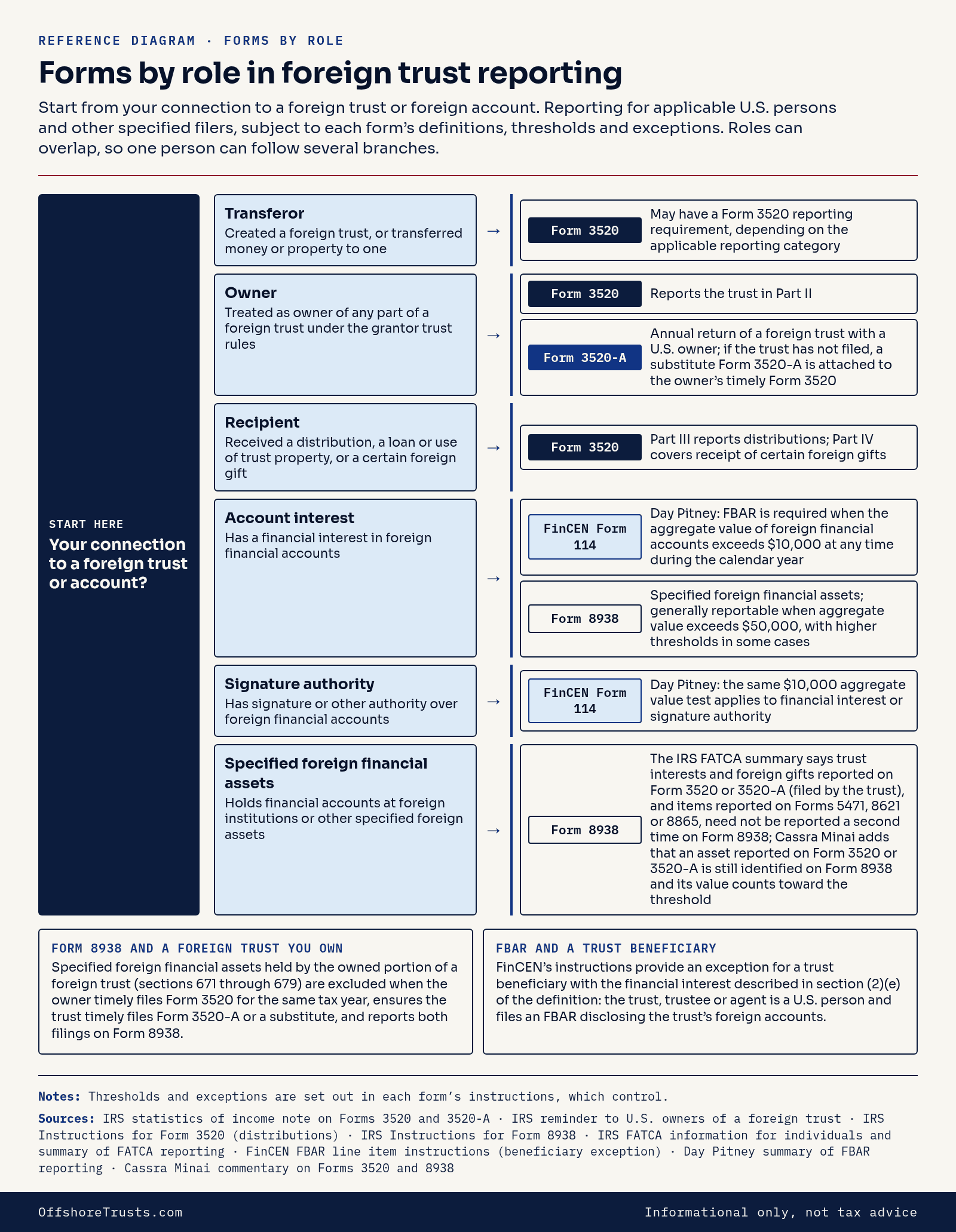
Data table for this infographic
| Role or topic | Connection or condition | Form or reporting | Details |
|---|---|---|---|
| Start here | Your connection to a foreign trust or account? | Roles can overlap, so one person can follow several branches. | |
| Transferor | Created a foreign trust, or transferred money or property to one | Form 3520 | May have a Form 3520 reporting requirement, depending on the applicable reporting category |
| Owner | Treated as owner of any part of a foreign trust under the grantor trust rules | Form 3520 | Reports the trust in Part II |
| Owner | Treated as owner of any part of a foreign trust under the grantor trust rules | Form 3520-A | Annual return of a foreign trust with a U.S. owner; if the trust has not filed, a substitute Form 3520-A is attached to the owner's timely Form 3520 |
| Recipient | Received a distribution, a loan or use of trust property, or a certain foreign gift | Form 3520 | Part III reports distributions; Part IV covers receipt of certain foreign gifts |
| Account interest | Has a financial interest in foreign financial accounts | FinCEN Form 114 | Day Pitney: FBAR is required when the aggregate value of foreign financial accounts exceeds $10,000 at any time during the calendar year |
| Account interest | Has a financial interest in foreign financial accounts | Form 8938 | Specified foreign financial assets; generally reportable when aggregate value exceeds $50,000, with higher thresholds in some cases |
| Signature authority | Has signature or other authority over foreign financial accounts | FinCEN Form 114 | Day Pitney: the same $10,000 aggregate value test applies to financial interest or signature authority |
| Specified foreign financial assets | Holds financial accounts at foreign institutions or other specified foreign assets | Form 8938 | Trust interests and foreign gifts reported on Form 3520 or 3520-A, and items reported on Forms 5471, 8621 or 8865, need not be reported a second time on Form 8938. The asset is still identified on Form 8938, and its value counts toward the threshold. |
| Form 8938 and a foreign trust you own | Treated as owner of any part of a foreign trust under the grantor trust rules | Form 8938 | Specified foreign financial assets held by the owned portion of a foreign trust (sections 671 through 679) are excluded when the owner timely files Form 3520 for the same tax year, ensures the trust timely files Form 3520-A or a substitute, and reports both filings on Form 8938. |
| FBAR and a trust beneficiary | Trust beneficiary with a financial interest in the trust's foreign financial accounts | FinCEN Form 114 | FinCEN's instructions provide an exception for a trust beneficiary with the financial interest described in section (2)(e) of the definition: the trust, trustee or agent is a U.S. person and files an FBAR disclosing the trust's foreign accounts. |
Notes: Thresholds and exceptions are set out in each form’s instructions, which control.
Sources: IRS statistics of income note on Forms 3520 and 3520-A · IRS reminder to U.S. owners of a foreign trust · IRS Instructions for Form 3520 (distributions) · IRS Instructions for Form 8938 · IRS FATCA information for individuals and summary of FATCA reporting · FinCEN FBAR line item instructions (beneficiary exception) · Day Pitney summary of FBAR reporting · Cassra Minai commentary on Forms 3520 and 8938 · OffshoreTrusts.com
Questions and answers
Does U.S. citizenship alone create a Form 3520-A filing requirement?
The instructions tie Form 3520-A to a foreign trust with a U.S. owner. Citizenship is included in the U.S. person definition, while owner status depends on the grantor trust rules.[2]
Who signs the return?
The instructions assign the regular return's signature to the foreign trust's trustee. A U.S. owner signs a substitute return and supplies the owner's name and taxpayer identification number on the signature box's Title line.[2]
Are there exceptions for retirement or other benefit arrangements?
The instructions identify reporting exemptions for certain Canadian retirement plans. They also describe exemptions under Rev. Proc. 2020-17 for certain eligible individuals and qualifying retirement, medical, disability, or educational trusts.[2]
Does a reporting exemption also remove other foreign asset reporting?
The IRS states that these exceptions leave any applicable Form 8938 obligations in place. Other reporting requirements, including FBAR, also remain subject to their own rules.[3]
Related resources
Related glossary terms
- Substitute Form 3520-A: A substitute Form 3520-A is filed by a U.S. owner when a foreign trust fails to file its annual return, and it carries its own timing and statement rules.
- Foreign grantor trust owner statement: The Instructions for Form 3520-A identify the Foreign Grantor Trust Owner Statement as pages 3 and 4 of the foreign trust's annual information return.
Related articles and guides
- Foreign trust forms and the accounts behind them: Forms 3520 and 3520-A cover transfers to a foreign trust, its ownership and its distributions. Bank accounts behind a trust add separate FBAR and 8938 rules.
- Form 8938 and Foreign Trust Assets: A U.S. citizen's guide to Form 8938: what counts as a specified foreign financial asset, when the form accompanies a tax return, and how filing thresholds vary.
Related pages
- IRS forms: All form reference pages.
- FinCEN Report 114 (FBAR): foreign account reporting
- Form 1041: income tax return for estates and trusts
- Form 1116: foreign tax credit
- Form 2555: foreign earned income exclusion
- IRS form finder: Search the forms by keyword.
Sources and data notes
- Internal Revenue Service, About Form 3520-A. https://www.irs.gov/forms-pubs/about-form-3520-a. Retrieved .
- Internal Revenue Service, Instructions for Form 3520-A. https://www.irs.gov/instructions/i3520a. Retrieved .
- Internal Revenue Service, Foreign trust reporting requirements and tax consequences. https://www.irs.gov/businesses/international-businesses/foreign-trust-reporting-requirements-and-tax-consequences. Retrieved .
Dates in this block record when each source was read for this page.