
FinCEN Report 114 (FBAR): foreign account reporting
FinCEN Report 114, the FBAR, reports foreign financial accounts held by U.S. persons, including financial interests, signature authority and trust provisions.
What the FBAR reports
The FBAR reports specified relationships with foreign financial accounts through FinCEN Form 114. The IRS describes it as a report to the Treasury Department and identifies bank accounts, brokerage accounts, and mutual funds as examples of accounts within its scope.[1]
For a U.S. citizen, the starting point is the reporting rule for U.S. persons who have a financial interest in, or signature or other authority over, foreign accounts. The IRS states that the accounts' combined value must have exceeded $10,000 at any point during the calendar year being reported.[1]
Who falls within the reporting rule
A U.S. citizen is among the U.S. persons covered by the IRS filing rule. The IRS list also includes residents, corporations, partnerships, limited liability companies, trusts, and estates, so the stated scope extends beyond individual account holders.[1]
The regulation includes entities formed under the laws of the United States, a state, the District of Columbia, U.S. territories and insular possessions, or Indian Tribes. Its entity definition expressly names corporations, partnerships, trusts, and limited liability companies.[3]
The $10,000 test applies to the aggregate value of the foreign accounts covered by the rule. The IRS also states that an account's production of taxable income does not determine whether it is a foreign financial account for FBAR purposes.[1]
What counts as a financial account
Reportable account categories include bank accounts, securities accounts, and specified other financial accounts. The IRS generally treats an account at a financial institution outside the United States as a foreign financial account.[1]
- Bank accounts include savings deposits, demand deposits, checking accounts, and other accounts maintained with a person engaged in banking.[3]
- Securities accounts include accounts with a person whose business involves buying, selling, holding, or trading stocks or other securities.[3]
- Other financial accounts include accounts with a person whose business accepts deposits as a financial agency, and insurance or annuity policies that have cash value.[3]
- The regulation includes accounts with brokers or dealers for commodity futures or options transactions on, or subject to, an exchange's or association's rules.[3]
- It also includes mutual funds or similar pooled funds with publicly available shares, regular net asset value determinations, and regular redemptions.[3]
How financial interest is defined
Financial interest includes being the account's owner of record or holding its legal title, even when the account benefits someone else. For a jointly named account, each U.S. person named on the account has a financial interest under the regulation.[3]
The definition also reaches an account held by an agent, nominee, attorney, or another person acting on behalf of the U.S. person. A U.S. citizen's name therefore need not appear as the account holder for this part of the definition to apply.[3]
For corporate accounts, the definition includes direct or indirect ownership of more than 50 percent of voting power or total share value. For partnerships, it includes more than 50 percent of profits or capital; the regulation also specifies ownership tests for other entities, with separate provisions for the trusts described below.[3]
How the regulation treats trusts
The regulation includes a trust account within a U.S. person's financial interest when that person is the grantor and has an ownership interest in the trust for U.S. federal tax purposes. It refers to Internal Revenue Code sections 671 through 679 and their regulations to determine that ownership interest.[3]
A separate provision covers a trust in which the U.S. person has a present beneficial interest in more than 50 percent of the assets. It also covers a trust from which that person receives more than 50 percent of current income.[3]
Beneficiaries covered by that separate provision are exempt from reporting the trust's foreign accounts when the trust, its trustee, or its agent is a U.S. person that files an FBAR disclosing those accounts. The exception depends on that reporting condition, so beneficiary status alone does not establish it.[3]
Signature authority and reporting exceptions
Signature or other authority means an individual's power to direct the disposition of account assets through communication with the account provider. The definition applies whether the individual acts alone or together with another person, and whether the communication is written or takes another form.[3]
The IRS lists exceptions for accounts held in an IRA for its owner or beneficiary and accounts held in a retirement plan for its participant or beneficiary. The regulation identifies the retirement plan and IRA provisions to which its exception applies.[1][3]
The IRS also states that a person need not file separately when all of that person's foreign accounts appear on a consolidated FBAR. The regulation permits qualifying U.S. entities with more than a 50 percent interest in other reporting entities to submit a consolidated report for themselves and those entities.[1][3]
Reporting timing and filing method
The FBAR is an annual report due April 15 of the year following the calendar year it covers. The IRS describes an automatic extension to October 15 that does not require an extension request.[1]
The IRS directs electronic filing through FinCEN's BSA E-Filing System and states that the FBAR is filed separately from the federal tax return. FinCEN allows individuals filing their own reportable accounts to file electronically without registering for a BSA E-Filing account.[1][2]
Paper filing requires an exemption requested from FinCEN's Resource Center. If FinCEN approves the request, it supplies the paper form and mailing instructions; the IRS states that a printed electronic Form 114 is not accepted as a paper filing.[1]
Penalties for missed reports
The FBAR carries civil penalties that scale with willfulness. A non-willful failure can draw a penalty per violation, and no penalty applies when there is reasonable cause and the balance is properly reported. A willful failure can draw the greater of an inflation-adjusted amount (set at $100,000 in the statute) or 50% of the account balance at the time of the violation, and willful violations can also carry criminal exposure.[1]
Authorization and account records
FinCEN Report 114a records authorization for another person to file an FBAR on the account holder's behalf. The IRS says this authorization is retained with the records and made available on request, without being submitted with the FBAR.[1]
The IRS generally requires account records to be retained for five years from the FBAR due date. Bank statements or a copy of the filed FBAR can serve as records if they contain the required information.[1]
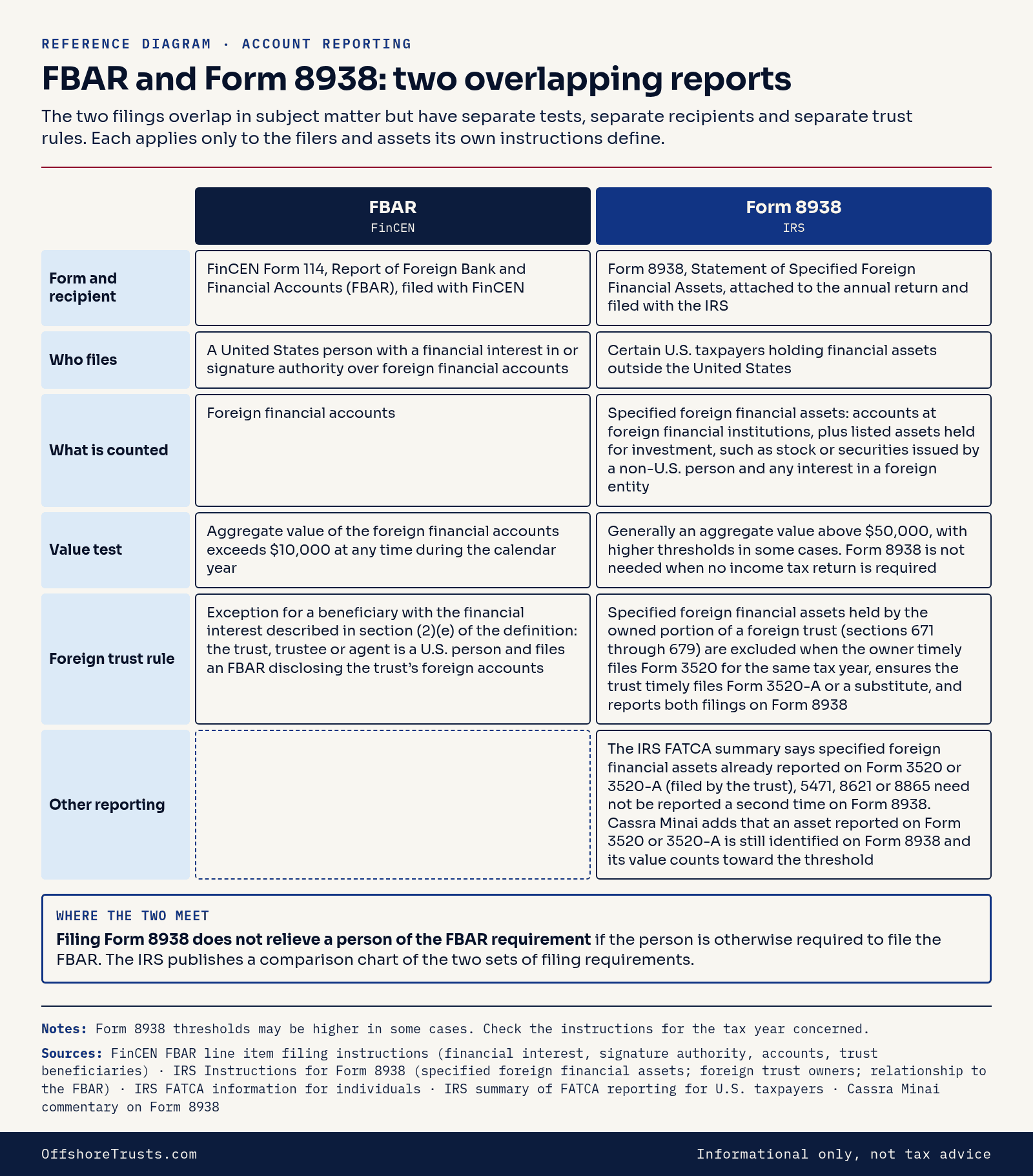
Data table for this infographic
| Topic | FBAR | Form 8938 |
|---|---|---|
| Summary | The two filings overlap in subject matter but have separate tests, separate recipients and separate trust rules. | |
| Form and recipient | FinCEN Form 114, Report of Foreign Bank and Financial Accounts (FBAR), filed with FinCEN | Form 8938, Statement of Specified Foreign Financial Assets, attached to the annual return and filed with the IRS |
| Who files | A United States person with a financial interest in or signature authority over foreign financial accounts | Certain U.S. taxpayers holding financial assets outside the United States |
| What is counted | Foreign financial accounts | Specified foreign financial assets: accounts at foreign financial institutions, plus listed assets held for investment, such as stock or securities issued by a non-U.S. person and any interest in a foreign entity |
| Value test | Aggregate value of the foreign financial accounts exceeds $10,000 at any time during the calendar year | Generally an aggregate value above $50,000, with higher thresholds in some cases. Form 8938 is not needed when no income tax return is required |
| Foreign trust rule | Exception for a beneficiary whose financial interest in a trust account rests on a present beneficial interest in more than 50 percent of the trust assets or current income: no filing is needed when the trust, trustee or agent is a U.S. person and files an FBAR disclosing the trust's foreign accounts | Specified foreign financial assets held by the owned portion of a foreign trust (sections 671 through 679) are excluded when the owner timely files Form 3520 for the same tax year, ensures the trust timely files Form 3520-A or a substitute, and reports both filings on Form 8938 |
| Other reporting | Specified foreign financial assets already reported on Form 3520 or 3520-A (filed by the trust), 5471, 8621 or 8865 need not be reported a second time on Form 8938. The asset is still identified on Form 8938, and its value counts toward the threshold. | |
| Where the two meet | Filing Form 8938 does not relieve a person of the FBAR requirement if the person is otherwise required to file the FBAR. The IRS publishes a comparison chart of the two sets of filing requirements. | |
| Notes | Form 8938 thresholds may be higher in some cases. The instructions for the tax year concerned govern. | |
| Sources | FinCEN FBAR line item filing instructions (financial interest, signature authority, accounts, trust beneficiaries) · IRS Instructions for Form 8938 (specified foreign financial assets; foreign trust owners; relationship to the FBAR) · IRS FATCA information for individuals · IRS summary of FATCA reporting for U.S. taxpayers · Cassra Minai commentary on Form 8938 | |
Questions and answers
Does my account need to earn taxable income?
Taxable income does not determine whether an account is foreign for FBAR purposes. The IRS filing rule instead identifies the account relationship and the aggregate value threshold.[1]
Can my spouse report our joint accounts?
The IRS describes an exception when all foreign accounts are jointly owned with a spouse, signed Form 114a authorizes that spouse to file, and the spouse reports them on a timely signed FBAR. Income tax filing status does not determine eligibility for this exception.[1]
Does holding accounts for someone else create a financial interest?
The regulation includes an owner of record or legal title holder even when an account benefits another person. It separately includes accounts held by someone acting on behalf of a U.S. person.[3]
What changes if I have 25 or more foreign accounts?
The regulation provides special reporting rules for financial interests in, or signature authority over, 25 or more foreign accounts. These rules permit reporting account numbers and certain basic information, while detailed information about each account remains required upon request.[3]
Related resources
Related glossary terms
- FBAR: FinCEN describes the FBAR filing rule for U.S. persons with foreign accounts. It covers the $10,000 aggregate threshold, account interests and exceptions.
- Signature authority over an account: The FBAR rules define signature authority by the power to direct disposition of account funds through direct communication with the financial institution.
- Financial interest in an account: FBAR rules define financial interest through account ownership or relationships to the legal title holder. A U.S. person named on an account has an interest.
Related articles and guides
- FBAR Rules for Trust Beneficiaries: A reference for U.S. citizens on the FBAR value threshold, financial interests, signature authority, and the reporting rule for certain trust beneficiaries.
Related pages
- IRS forms: All form reference pages.
- Form 1041: income tax return for estates and trusts
- Form 1116: foreign tax credit
- Form 2555: foreign earned income exclusion
- Form 3520-A: annual information return of a foreign trust
- IRS form finder: Search the forms by keyword.
- Self-directed IRAs, foreign assets and trust structures: Self-directed IRA structures that hold foreign assets: prohibited transactions, account reporting duties and where retirement account tax rules stop applying.
- Second citizenship and U.S. tax obligations: Understand how second citizenship affects a U.S. citizen's worldwide income reporting, foreign accounts, earned income exclusions and expatriation tax duties.
Sources and data notes
- Internal Revenue Service, Report of Foreign Bank and Financial Accounts (FBAR). https://www.irs.gov/businesses/small-businesses-self-employed/report-of-foreign-bank-and-financial-accounts-fbar. Retrieved .
- Financial Crimes Enforcement Network, Report foreign bank and financial accounts. https://www.fincen.gov/report-foreign-bank-and-financial-accounts. Retrieved .
- U.S. Government (eCFR), 31 C.F.R. 1010.350 Reports of foreign financial accounts. https://www.law.cornell.edu/cfr/text/31/1010.350. Retrieved .
Dates in this block record when each source was read for this page.