
Section 6048
The Internal Revenue Code describes Section 6048 as a set of information rules for certain foreign trusts. For a U.S. citizen, the section connects reportable events, foreign trust ownership, and distributions with IRS reporting.
What section 6048 covers
The Internal Revenue Code describes Section 6048 as information reporting for certain foreign trusts. It has three main parts: notice of certain events, information duties for a U.S. owner, and reporting by U.S. beneficiaries who receive distributions.[6]
The Form 3520 instructions connect the section to a U.S. person's reporting of certain foreign trust transactions and ownership under sections 671 through 679. They also identify Form 3520-A as the annual information return for a foreign trust with a U.S. owner.[1]
Events and responsible parties
Section 6048(a) treats creation of a foreign trust by a U.S. person, a transfer to one, and certain deaths as reportable events. After an event, the responsible party gives written notice to the Secretary within 90 days or a later prescribed period.[6]
For an inter vivos trust's creation, the grantor is responsible. For a covered transfer other than one by reason of death, the transferor is responsible; in other cases, the decedent's executor is responsible.[6]
The statute excludes a property transfer in exchange for consideration at least equal to fair market value from this transfer-event rule. It also excludes specified deferred compensation trusts and trusts determined to qualify under section 501(c)(3).[6]
Owners and beneficiaries
Under subsection (b), a U.S. person treated as owner of any part of a foreign trust during a tax year submits prescribed information and is responsible for the trust's annual return and information statements. The trust's information goes to each U.S. owner and each U.S. person receiving a distribution.[6]
A trust within subsection (b) generally authorizes a U.S. person as a limited agent for specified IRS record examination and testimony procedures. If the required agent arrangement is absent, the statute says the Secretary determines amounts that the U.S. owner must take into account under the grantor trust rules.[6]
Subsection (c) applies when a U.S. person receives a foreign trust distribution, directly or indirectly. The return includes the trust's name and aggregate distributions, along with other prescribed information. The Form 3520 instructions define a reportable distribution broadly as a gratuitous transfer, whether or not the recipient is named as a beneficiary.[1][6]
Related forms and terms
Form 3520 is the U.S. person's return for covered transactions and ownership, while Form 3520-A carries the foreign trust's annual information. The instructions also identify loans and uncompensated use of trust property as matters that may be treated as distributions for reporting purposes.[1]
Section 6048 also supplies a special rule for deciding whether a U.S. person made a transfer or received a distribution. That decision disregards the fact that another person is treated as owner of a portion of the trust under the grantor trust rules.[6]
A separate statutory rule allows a U.S. trust with substantial activities or property outside the United States to be treated as a foreign trust for this section, to the extent regulations provide. Section 6048 also permits the Secretary to modify or suspend a reporting requirement when the United States has no significant tax interest in the information.[6]
Reportable event
Under section 6048(a), a reportable event includes creation of a foreign trust by a U.S. person, a transfer of money or property to a foreign trust by a U.S. person, and certain deaths of U.S. citizens or residents. The Form 3520 instructions include direct and indirect transfers by a U.S. person, transfers attributed to a person because of death, and transfers treated as occurring under specified statutory provisions.[1]
The death of a U.S. citizen or resident is covered when the decedent was treated as owner of any part of a foreign trust under the grantor trust rules or any part of a foreign trust was included in the decedent's gross estate.[1] Section 6048 excludes from the transfer category a transfer for consideration at least equal to fair market value. The reportable event definition in section 6048(a)(3)(A) does not apply to trusts described in sections 402(b), 404(a)(4), or 404A, or trusts determined by the Secretary to be described in section 501(c)(3).[6]
The term appears in Part I of Form 3520, which addresses transfers by U.S. persons to a foreign trust. The instructions direct the responsible party to complete Part I for a reportable event in the tax year and direct Schedule B reporting for reportable events during that year. Form 3520 is also used by U.S. persons and executors of U.S. decedents to report certain foreign trust transactions and ownership under the grantor trust rules. A separate form applies to transactions with each foreign trust.[1]
Section 6048 describes written notice to the Secretary after a reportable event. The notice includes the amount of money or property transferred, if any, and the identity of the trust and trustees, along with beneficiaries or beneficiary class. The responsible party depends on the event: for creating an inter vivos trust, the grantor is responsible; for a non-death transfer, the transferor is responsible; and in other cases, the decedent's estate executor is responsible.[6]
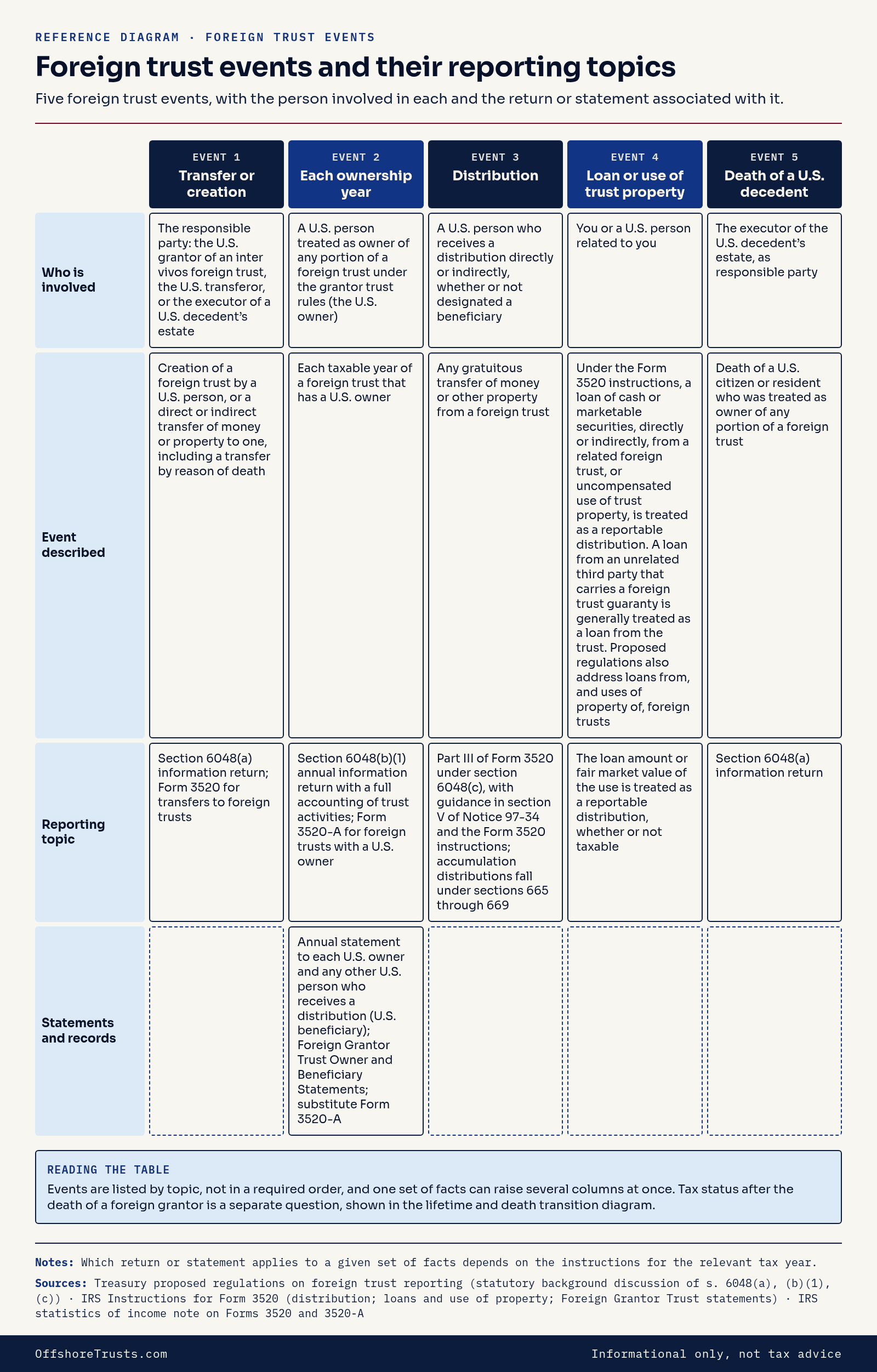
Data table for this infographic
| Event group | Event described | Who is involved | Reporting topic | Statements and records |
|---|---|---|---|---|
| Transfer or creation | Creation of a foreign trust by a U.S. person, or a direct or indirect transfer of money or property to one, including a transfer by reason of death | The responsible party: the U.S. grantor of an inter vivos foreign trust, the U.S. transferor, or the executor of a U.S. decedent's estate | Section 6048(a) information return; Form 3520 for transfers to foreign trusts | Records of the trust creation and of each direct or indirect transfer of money or property to the foreign trust, including transfers by reason of death |
| Each ownership year | Each taxable year of a foreign trust that has a U.S. owner | A U.S. person treated as owner of any portion of a foreign trust under the grantor trust rules (the U.S. owner) | Section 6048(b)(1) annual information return with a full accounting of trust activities; Form 3520-A for foreign trusts with a U.S. owner | Annual statement to each U.S. owner and any other U.S. person who receives a distribution (U.S. beneficiary); Foreign Grantor Trust Owner and Beneficiary Statements; substitute Form 3520-A |
| Distribution | Any gratuitous transfer of money or other property from a foreign trust | A U.S. person who receives a distribution directly or indirectly, whether or not designated a beneficiary | Part III of Form 3520 under section 6048(c), with guidance in section V of Notice 97-34 and the Form 3520 instructions; accumulation distributions fall under sections 665 through 669 | Annual statement to each U.S. person who receives a distribution (U.S. beneficiary) from a foreign trust with a U.S. owner; Foreign Grantor Trust Beneficiary Statement |
| Loan or use of trust property | Under the Form 3520 instructions, a loan of cash or marketable securities, directly or indirectly, from a related foreign trust, or uncompensated use of trust property, is treated as a reportable distribution. A loan from an unrelated third party that carries a foreign trust guaranty is generally treated as a loan from the trust. Proposed regulations also address loans from, and uses of property of, foreign trusts. | You or a U.S. person related to you | The loan amount or fair market value of the use is treated as a reportable distribution, whether or not taxable | Records of the loan amount, any foreign trust guaranty, or the fair market value of the use of trust property |
| Death of a U.S. decedent | Death of a U.S. citizen or resident who was treated as owner of any portion of a foreign trust | The executor of the U.S. decedent's estate, as responsible party | Section 6048(a) information return | Records supporting the decedent's treatment as owner of the foreign trust at death |
| Reading the table | Events are listed by topic, not in a required order, and one set of facts can raise several columns at once. | Tax status after the death of a foreign grantor is a separate question, shown in the lifetime and death transition diagram. | ||
Questions and answers
What events count as reportable events under Section 6048?
The statute lists creation of a foreign trust by a U.S. person, transfers of money or property to it, and certain deaths of U.S. citizens or residents. It excludes specified fair market value transfers and certain deferred compensation or charitable trusts.[6]
Who gives notice after a reportable event?
The responsible party provides written notice within 90 days, or a later period prescribed by the Secretary. Depending on the event, that party is the grantor, transferor, or executor of the decedent's estate.[6]
What does Section 6048 require of a U.S. owner?
A U.S. person treated as owner of part of a foreign trust submits prescribed information for the tax year. The person is also responsible for the trust's annual return and for providing information to U.S. owners and distribution recipients.[6]
When does a U.S. person report a foreign trust distribution?
Subsection (c) applies if a U.S. person receives any distribution from a foreign trust, directly or indirectly, during the person's tax year. The return reports the trust's name and total distributions, plus other prescribed information.[6]
How do Forms 3520 and 3520-A relate to Section 6048?
The Form 3520 instructions associate Form 3520 with certain foreign trust transactions and ownership by U.S. persons. They identify Form 3520-A as the annual information return of a foreign trust with a U.S. owner.[1]
Related terms
- Responsible party: The Instructions for Form 3520 define the responsible party for specified events involving a foreign trust. The role differs from an owner or U.S. agent.
- Transfer to a foreign trust: Form 3520 covers direct and indirect transfers of money or property to a foreign trust, including gratuitous transfers, alongside the U.S. ownership rules.
- Grantor: Form 3520 describes a grantor as a person who creates a trust, transfers property to it without full value, or is treated as an owner under specified rules.
Related guides and articles
- Section 6048 reporting for certain foreign trusts: Section 6048 foreign trust reporting for U.S. citizens, including definitions and reportable events, as well as ownership and distributions and the IRS forms.
- Settlor, trustee and beneficiary roles: Trust structure and the roles of settlors and of trustees, and of beneficiaries, tied to the IRS instructions for Form 3520 that apply to U.S. citizens.
- Foreign gifts and trust distributions: Form 3520 reports foreign trust distributions and certain gifts from foreign persons. Reporting does not by itself determine whether a receipt is taxable.
Related pages
Sources and data notes
- Internal Revenue Service, Instructions for Form 3520. https://www.irs.gov/instructions/i3520. Retrieved .
- Internal Revenue Service, Instructions for Form 3520-A. https://www.irs.gov/instructions/i3520a. Retrieved .
- Internal Revenue Service, 26 CFR 301.7701-7 Trusts, domestic and foreign. https://ecfr.io/Title-26/Section-301.7701-7. Retrieved .
- Internal Revenue Service, 26 CFR 301.7701-4 Trusts. https://www.ecfr.gov/current/title-26/section-301.7701-4. Retrieved .
- Internal Revenue Service, 26 U.S.C. 679. https://uscode.house.gov/us/usc/119-118/t26/s679/. Retrieved .
- Internal Revenue Service, 26 U.S.C. 6048. https://uscode.house.gov/us/usc/119-118/t26/s6048/. Retrieved .
- Internal Revenue Service, Foreign trust reporting requirements and tax consequences. https://www.irs.gov/businesses/international-businesses/foreign-trust-reporting-requirements-and-tax-consequences. Retrieved .
Dates in this block record when each source was read for this page.