
Reserved Powers in Trust Instruments
A trust instrument may reserve powers to a settlor or grant them to another person. Listed jurisdictional statutes also address trust validity and whether exercising a listed power makes its holder a trustee.
Powers written into a trust instrument
A trust instrument can assign specified powers to a settlor or another person, sometimes described as a protector. The powers include changing the trust, influencing trustee decisions, and appointing or removing office holders.[5]
- Amendment and revocation. The BVI statute lists powers to revoke, vary, or amend trust terms, in whole or in part.[8]
- Trustee appointments. A power holder may be given authority to appoint, add, remove, or replace trustees. Delaware law also provides for an adviser, including a protector, to hold powers stated in the governing instrument.[1]
- Investment directions. The instrument may give a person power to direct a trustee concerning investments or the purchase, retention, or sale of trust property.[6]
- Consent conditions. The instrument may limit a trustee's ability to exercise a function unless a named person consents. In Guernsey, a requirement for a protector's consent can operate as a veto over an action.[5]
- Other powers. These powers also include powers over distributions, beneficiary classes, governing law, and administration forum.[4]
The instrument's terms identify the holder and scope of a power. Powers may take three forms: a person may take an action directly, a trustee may need that person's consent, or the person may direct the trustee to act.[5]
In Guernsey, a trustee action requiring consent may be ineffective when the required consent was not obtained.[5]
What the listed laws say about validity
The listed jurisdictional statutes address whether specified reserved or granted powers alone invalidate a trust. Their provisions are tied to their own laws and listed power categories.[2]
Jersey's statute lists powers including changing trust terms, directing dealings with trust property, appointing or removing trustees, and requiring consent for trustee powers. It says reservation or grant of those powers does not by itself make the settlor or power holder a trustee.[2]
Guernsey's statute permits a settlor to reserve or grant powers such as revocation, amendment, investment directions, and consent requirements. The statute also expressly addresses validity for specified powers and interests.[5]
Cayman and BVI statutes likewise address whether specified reserved powers invalidate a trust. The BVI examples include directions about investments, trustee appointments, and changes to beneficiary classes.[4]
These statements describe the treatment of listed powers under the named jurisdictions' laws. They do not establish that every power, every instrument, or every trust in another jurisdiction has the same treatment.[3]
Reading the statutory descriptions
Holding a listed power and legally serving as trustee are distinct questions. Jersey expressly says the reservation or grant, by itself, does not make the settlor or recipient a trustee, while Delaware permits an adviser or protector to hold authority defined by the instrument.[2]
These provisions describe powers and legal status under specific jurisdictions and do not establish a universal rule across all trust laws.[2]
Local validity is a separate question from U.S. treatment. A statute that keeps a trust valid despite reserved powers does not decide the U.S. result. A power to revoke, to direct distributions back to the settlor, or to veto trustee decisions can make the trust a grantor trust under sections 671 to 679, so the settlor reports the trust's income and the foreign trust forms. The legal effect of retained control depends on the governing law and the facts.
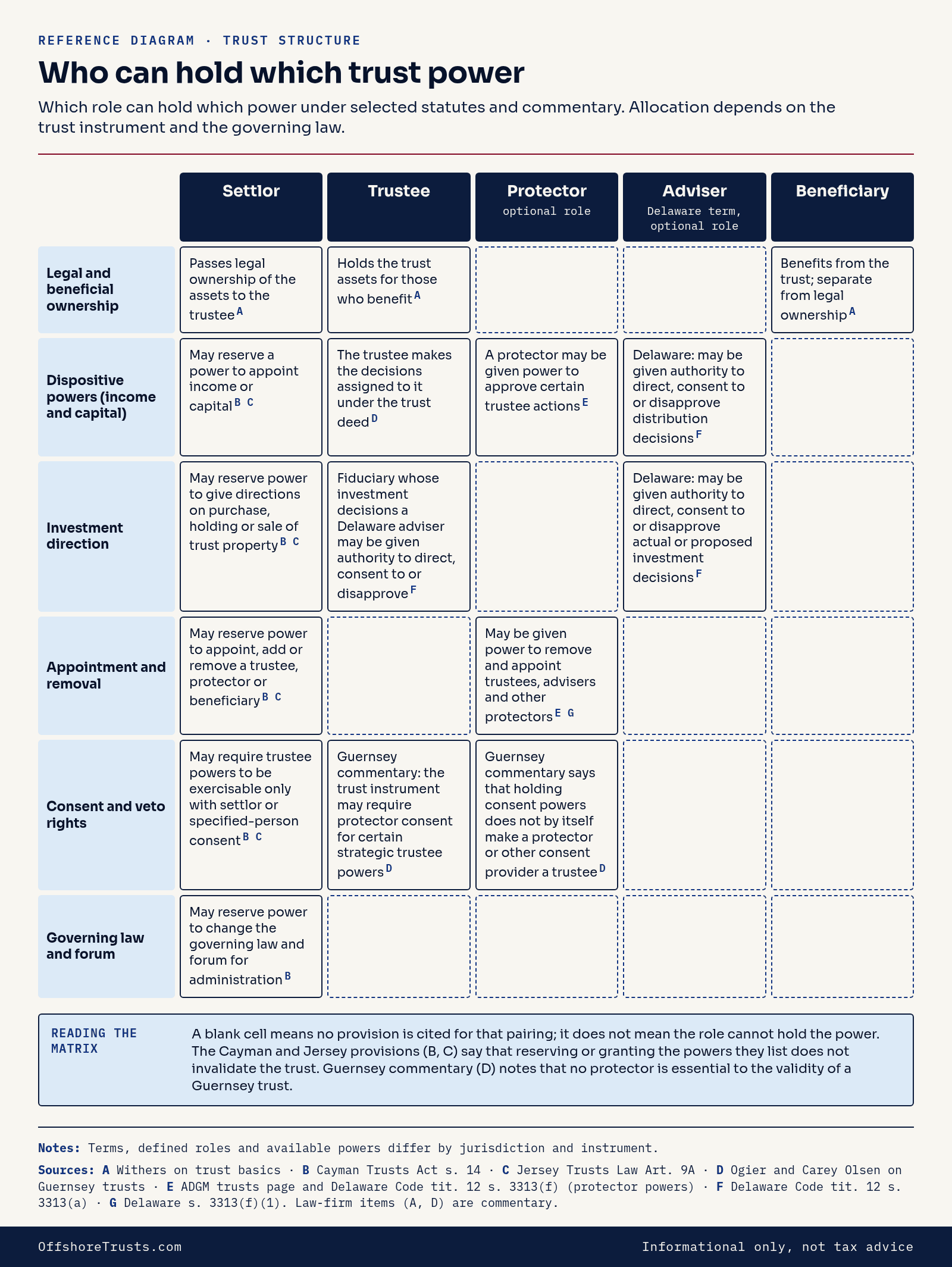
Data table for this infographic
| Power or topic | Settlor | Trustee | Protector | Investment adviser | Beneficiary |
|---|---|---|---|---|---|
| Legal and beneficial ownership | Passes legal ownership of the assets to the trustee A | Holds the trust assets for those who benefit A | Not covered | Not covered | Benefits from the trust; separate from legal ownership A |
| Dispositive powers (income and capital) | May reserve a power to appoint income or capital B C | The trustee makes the decisions assigned to it under the trust deed D | A protector may be given power to approve certain trustee actions E | Delaware: May be given authority to direct, consent to or disapprove distribution decisions F | Not covered |
| Investment direction | May reserve power to give directions on purchase, holding or sale of trust property B C | Fiduciary whose investment decisions a Delaware adviser may be given authority to direct, consent to or disapprove F | Not covered | Delaware: May be given authority to direct, consent to or disapprove actual or proposed investment decisions F | Not covered |
| Appointment and removal | May reserve power to appoint, add or remove a trustee, protector or beneficiary B C | Not covered | May be given power to remove and appoint trustees, advisers and other protectors E G | Not covered | Not covered |
| Consent and veto rights | May require trustee powers to be exercisable only with settlor or specified-person consent B C | Guernsey: the trust instrument may require protector consent for certain strategic trustee powers D | In Guernsey, holding consent powers does not by itself make a protector or other consent provider a trustee D | Not covered | Not covered |
| Governing law and forum | May reserve power to change the governing law and forum for administration B | Not covered | Not covered | Not covered | Not covered |
| Reading the matrix | A cell marked "Not covered" means no provision is cited for that pairing; it does not mean the role cannot hold the power. The Cayman and Jersey provisions (B, C) say that reserving or granting the powers they list does not invalidate the trust. Under Guernsey law, a protector is not essential to the validity of a trust. Allocation depends on the trust instrument and the governing law. Terms, defined roles and available powers differ by jurisdiction and instrument. | ||||
| Notes and sources | Law-firm items (A, D) are commentary. A Withers on trust basics. B Cayman Trusts Act s. 14. C Jersey Trusts Law Art. 9A. D Ogier and Carey Olsen on Guernsey trusts. E ADGM trusts page and Delaware Code tit. 12 s. 3313(f) (protector powers). F Delaware Code tit. 12 s. 3313(a). G Delaware s. 3313(f)(1). | ||||
Reserved powers and trust administration
A trust instrument allocates authority among the settlor, trustees and other power holders. The instrument records the terms under which trustees hold and administer trust property, including powers kept by the settlor or granted to another person. Statutes in some jurisdictions recognize these allocations and state that reserving powers alone does not invalidate a trust.[9][10]
Listed powers cover investment directions, changes to trust terms, appointment or removal of trustees, and changes to the trust's proper law. Jersey law also lists directions about holding, managing, or selling trust property, and consent requirements that limit when trustees may exercise their powers. A letter of wishes is nonbinding, though trustees may consider it when administering a discretionary trust.[2][11]
Questions and answers
Can a trust instrument give someone power to amend or revoke a trust?
Guernsey, Cayman, and BVI law permit specified powers to revoke, vary, or amend trust terms. These powers are set out in the trust instrument.[6]
Can someone other than the trustee direct investments?
A trust instrument may authorize a settlor or another person to direct a trustee about investments or dealings with trust property. The scope of that authority depends on the instrument and applicable law.[5]
Can a person appoint or remove a trustee?
A trust instrument may grant powers to appoint, add, remove, or replace trustees. Delaware law also addresses powers an adviser or protector receives under the governing instrument.[6]
Can the trustee's actions require another person's consent?
Yes. Guernsey law permits a trust instrument to restrict a trustee function so it can be exercised only with consent from the settlor or another person named in the instrument.[5]
Do reserved powers automatically make their holder a trustee?
Jersey's statute says that reserving or granting a beneficial interest or listed powers does not, by itself, make the settlor or power recipient a trustee. This statement concerns the powers and conditions described in that law.[2]
Do specified reserved powers alone invalidate a trust?
Statutes in Jersey, Guernsey, Cayman, and the BVI address whether specified powers alone invalidate a trust. The treatment is jurisdiction-specific and applies to the powers each statute lists.[3]
Related resources
Related glossary terms
- Reserved powers: Reserved powers are rights a settlor keeps, or gives to another person, under a trust. Trust laws address their validity and their effect on administration.
- Settlor: A settlor is the person who creates a trust or transfers property into it.
- Nongrantor trust: A nongrantor trust is taxable to the extent its assets are not treated as owned by another person. Grantor trust treatment can apply to only part of a trust, and beneficiaries report the income distributed to them.
Related articles and guides
- Guernsey Trust Types and Features: Guernsey law defines trusts and describes discretionary and purpose trusts, with rules on reserved powers, trust duration and trust creation.
- 26 U.S.C. § 674, Power to control beneficial enjoyment: Section 674 treats a grantor as owner of part of a trust when the grantor or another person controls who enjoys principal or income, subject to exceptions.
- Trust types and duration under Seychelles law: Seychelles law recognizes beneficiary and purpose trusts, with rules on trustees and settlors and on trust duration, set out by statute for each trust type.
Tools and official documents
- Form 1041: income tax return for estates and trusts: Form 1041 is the U.S. income tax return for estates and trusts: filing categories, definitions, attachments, related forms and timing for a U.S. citizen.
Related pages
- Topic guides
- Protector powers, consent and duties
- Settlor, trustee and beneficiary roles
- What a trust means under U.S. and international law
- Fraudulent transfers and look-back periods for trust funding: How federal bankruptcy law and state fraudulent transfer statutes treat trust funding, including look-back periods, transferee liability and court challenges.
- Court enforcement and contempt risk for U.S. settlors: Court enforcement and civil contempt risk for an offshore trust: retained trust powers, the limits of an impossibility defense and the cases that shape both.
Sources and data notes
- delcode.delaware.gov, Delaware Code Online. https://delcode.delaware.gov/title12/c033/. Retrieved .
- jerseylaw.je, Trusts (Jersey) Law 1984. https://www.jerseylaw.je/laws/current/l_11_1984. Retrieved .
- careyolsen.com, Types and uses of Cayman Islands law trusts | Carey Olsen. https://www.careyolsen.com/insights/briefings/types-and-uses-cayman-islands-law-trusts. Retrieved .
- harneys.com, The use of British Virgin Islands Trusts in the Middle East. https://www.harneys.com/insights/the-use-of-british-virgin-islands-trusts-in-the-middle-east/. Retrieved .
- ogier.com, Reserving powers under Guernsey Trusts Law | Ogier. https://www.ogier.com/news-and-insights/insights/reserving-powers-under-guernsey-trusts-law/. Retrieved .
- ogier.com, Cayman Islands Reserved Powers Trusts | Ogier. https://www.ogier.com/news-and-insights/insights/cayman-islands-reserved-powers-trusts/. Retrieved .
- collascrill.com, Untangling the Webb | Collas Crill. https://www.collascrill.com/articles/untangling-the-webb-an-offshore-perspective-on-the-privy-council-case-of-webb-v-webb/. Retrieved .
- collascrill.com, An offshore perspective: reservation of powers in BVI trusts | Collas Crill. https://www.collascrill.com/articles/an-offshore-perspective-reservation-of-powers-in-bvi-trusts/. Retrieved .
- withersworldwide.com, Trusts: when might you want to reserve powers? | Withers. https://www.withersworldwide.com/en-gb/insight/read/trusts-when-might-you-want-to-reserve-powers-part-1. Retrieved .
- ogier.com, Overview of BVI Trusts | Ogier. https://www.ogier.com/news-and-insights/insights/overview-of-bvi-trusts/. Retrieved .
- careyolsen.com, Structuring options for holding wealth in Guernsey | Carey Olsen. https://www.careyolsen.com/insights/articles/structuring-options-holding-wealth-guernsey. Retrieved .
Dates in this block record when each source was read for this page.