
Protector powers, consent and duties
A trust protector's role depends on the powers that may appear in the trust instrument and on how governing law treats the role.
The role depends on the instrument and governing law
A protector is a person whose authority comes from the trust instrument and the law governing the trust. Delaware includes a protector within its statutory category of adviser and permits the instrument to grant powers such as trustee removal and appointment. Nevis treats a person authorized to direct, consent to, or disapprove specified trustee decisions as a protector when exercising that authority, unless the instrument says otherwise.[1][3]
A Guernsey trust does not require a protector for validity, and the instrument can specify whether trustee consent is needed for particular powers. The IRS glossary also describes a protector as an optional third party, with monitoring and replacement functions that depend on specified conditions.[6][9]
Powers and consent rights
Protector powers can range from consent over selected actions to authority to direct trustee decisions. Nevis law describes possible powers over distributions and investments, including directing a distribution, approving one, or directing investment choices involving trust property. The scope stated in the instrument determines which of these powers are included.[3]
Other possible powers include appointing or removing trustees and approving or vetoing trustee actions. Other possible powers in ADGM include adding or excluding beneficiaries and changing the governing law or forum of administration. Delaware states that the governing instrument may give an adviser, including a protector, powers such as appointing and removing trustees and modifying the instrument.[1][5]
A consent right does not have one universal effect across jurisdictions. In a Privy Council decision, an unqualified consent or veto provision, where the instrument was silent about how to exercise it, was treated as ordinarily leaving the holder with a wide independent discretion. On that approach, the protector may refuse consent even where the trustee's proposal falls within a reasonable range. The effect of a consent or veto power depends on the instrument and governing law.[2]
| Power | Description |
|---|---|
| Direct or approve distributions | Nevis law allows the instrument to grant direction and approval powers over distributions.[3] |
| Direct investment decisions | Nevis law allows the instrument to authorize directions about investment decisions and trust property.[3] |
| Appoint or remove trustees | Possible protector powers in Delaware and ADGM include appointing and removing trustees.[1][5] |
| Veto trustee actions | Possible protector powers in ADGM include approval or veto authority.[5] |
A protector's powers can raise the same two questions as a settlor's reserved powers. A protector who is the settlor, or who in practice acts for the settlor, can bring the trust within the grantor trust rules, and a court can treat a veto or removal power held for the settlor as retained control. How independent the protector is from the settlor bears on both questions.
Fiduciary and nonfiduciary treatment
Whether a protector has fiduciary duties depends on the governing law and the trust terms. Delaware's definitions distinguish advisers or protectors acting in a fiduciary capacity from those acting in a nonfiduciary capacity. Its statute therefore allows either classification under the applicable provisions.[1]
Nevis law states that, subject to the trust terms, a protector owes a fiduciary duty to beneficiaries or to the trust's purpose. Belize law likewise provides for a fiduciary duty subject to the instrument, while saying the protector is not regarded as a trustee when acting in that office.[3][7]
Under Guernsey law, consent powers alone do not automatically make their holder a trustee or quasi-trustee. Nevada law says protector powers are fiduciary in nature unless the trust instrument provides otherwise, and permits the instrument to define or reduce that fiduciary standard.[2][8]
How the instrument sets the boundaries
The instrument can define which decisions require consent, which powers the protector may exercise, and whether a default legal rule applies. Nevis and Belize statutes both describe powers conferred by the trust terms, alongside specified statutory powers. Nevada similarly makes protector authority subject to the instrument's terms and allows the instrument to define the applicable fiduciary standard.[3][7][8]
The label protector does not by itself determine the holder's powers or duties. The written provisions and governing law supply those details, including whether a protector directs, approves, or only monitors a trustee action.[1][9]
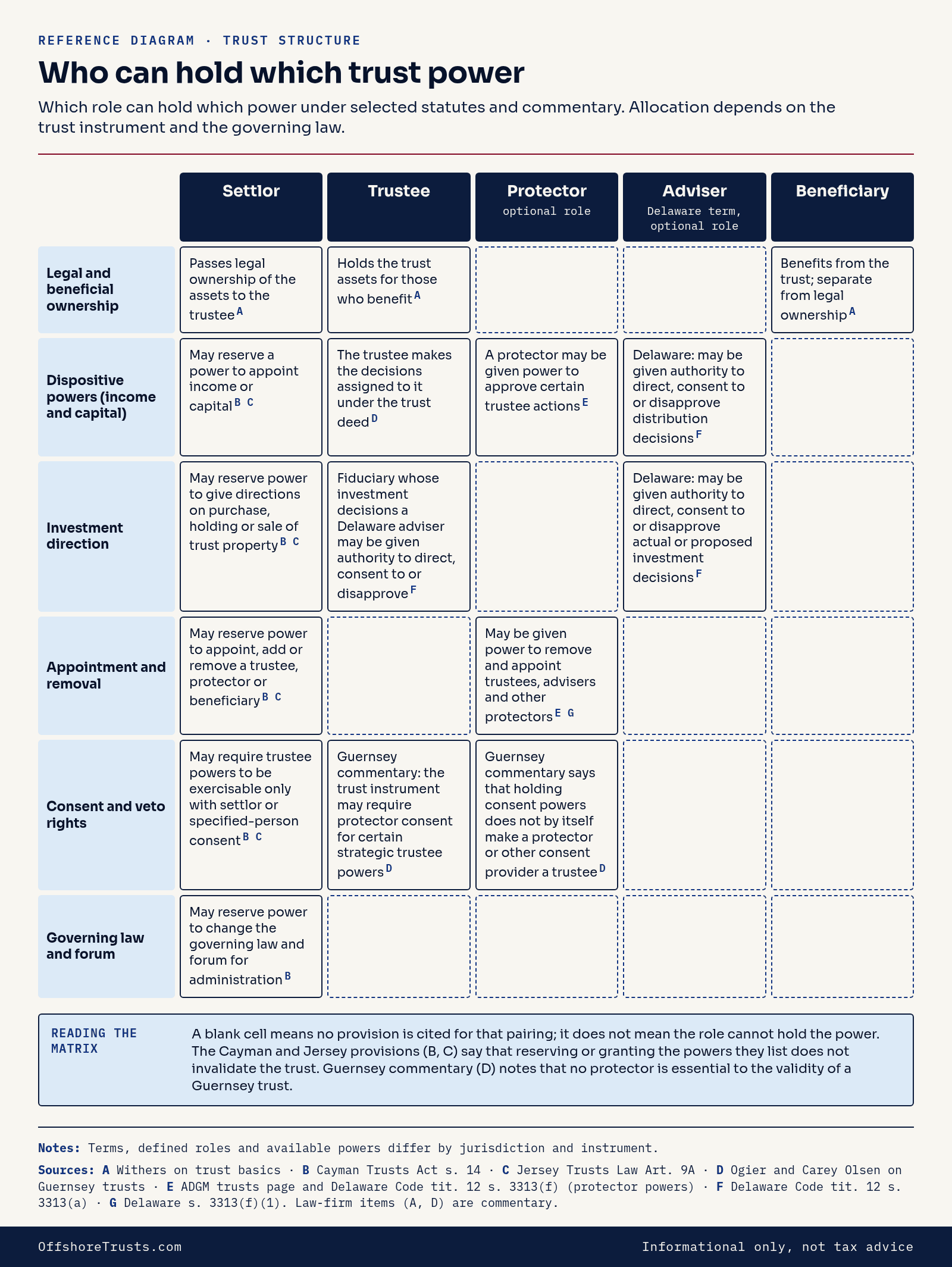
Data table for this infographic
| Power or topic | Settlor | Trustee | Protector | Investment adviser | Beneficiary |
|---|---|---|---|---|---|
| Legal and beneficial ownership | Passes legal ownership of the assets to the trustee A | Holds the trust assets for those who benefit A | Not covered | Not covered | Benefits from the trust; separate from legal ownership A |
| Dispositive powers (income and capital) | May reserve a power to appoint income or capital B C | The trustee makes the decisions assigned to it under the trust deed D | A protector may be given power to approve certain trustee actions E | Delaware: May be given authority to direct, consent to or disapprove distribution decisions F | Not covered |
| Investment direction | May reserve power to give directions on purchase, holding or sale of trust property B C | Fiduciary whose investment decisions a Delaware adviser may be given authority to direct, consent to or disapprove F | Not covered | Delaware: May be given authority to direct, consent to or disapprove actual or proposed investment decisions F | Not covered |
| Appointment and removal | May reserve power to appoint, add or remove a trustee, protector or beneficiary B C | Not covered | May be given power to remove and appoint trustees, advisers and other protectors E G | Not covered | Not covered |
| Consent and veto rights | May require trustee powers to be exercisable only with settlor or specified-person consent B C | Guernsey: The trust instrument may require protector consent for certain strategic trustee powers D | Guernsey: Holding consent powers does not by itself make a protector or other consent provider a trustee D | Not covered | Not covered |
| Governing law and forum | May reserve power to change the governing law and forum for administration B | Not covered | Not covered | Not covered | Not covered |
| Reading the matrix | A cell marked "Not covered" means no provision is cited for that pairing; it does not mean the role cannot hold the power. The Cayman and Jersey provisions (B, C) say that reserving or granting the powers they list does not invalidate the trust. Under Guernsey law (D), no protector is essential to the validity of a Guernsey trust. Allocation depends on the trust instrument and the governing law. Terms, defined roles and available powers differ by jurisdiction and instrument. | ||||
| Notes and sources | Law-firm items (A, D) are commentary. A Withers on trust basics. B Cayman Trusts Act s. 14. C Jersey Trusts Law Art. 9A. D Ogier and Carey Olsen on Guernsey trusts. E ADGM trusts page and Delaware Code tit. 12 s. 3313(f) (protector powers). F Delaware Code tit. 12 s. 3313(a). G Delaware s. 3313(f)(1). | ||||
When Trust Protectors Have Fiduciary Duties
Whether a trust protector has fiduciary duties depends in part on the capacity in which a particular power is held. A personal power is held outside a fiduciary capacity, while a fiduciary power carries duties to beneficiaries. For a personal power, the trustee follows the direction and checks that it does not violate the trust terms. For a fiduciary power, the trustee also checks whether the direction breaches a duty the protector owes beneficiaries. Classification can depend on the protector's identity and granted powers, making it case-specific.[13]
State statutes addressing trust protectors differ: some classify the role as fiduciary and others as nonfiduciary. The broader doctrine remains unsettled, so no single rule applies in every state.[13][14]
Under Uniform Trust Code section 808, a person other than a beneficiary who holds a power to direct is presumptively a fiduciary. The holder must act in good faith concerning the trust's purposes and beneficiaries' interests and is liable for losses resulting from a fiduciary breach. The Uniform Trust Code commentary states that a settlor may provide that a power holder is not held to fiduciary standards.[13]
The Uniform Directed Trust Act follows a related allocation principle: law of trusteeship attaches to the person holding the relevant power, even if that person is not formally a trustee. For a direction power, fiduciary responsibility attaches primarily to the trust director, while the directed trustee must not comply if compliance would constitute willful misconduct by the trustee.[15]
Under Uniform Trust Code section 808, a trustee must follow a direction unless its attempted exercise is manifestly contrary to the trust terms or the trustee knows it would constitute a serious breach of a fiduciary duty the power holder owes beneficiaries. The statutory direction rule applies to a power conferred on someone other than the settlor of a revocable trust.[13][14]
Questions and answers
Is every trust required to have a protector?
No. Guernsey law does not require a protector for a trust's validity, and the IRS glossary describes the role as optional. The trust instrument may provide for one and define the role.[6][9]
What powers can a protector have?
The instrument may grant powers over trustee appointment or removal, distributions, investments, or approval of trustee actions. The listed powers vary by governing law and by the provisions chosen for the trust.[3][5]
Does a protector's consent right always make the holder a trustee?
No. Under Guernsey law, holding consent powers does not automatically confer trustee or quasi-trustee status. Other duties may still depend on the governing law and instrument.[2]
Does every protector owe fiduciary duties?
Fiduciary treatment varies by jurisdiction. Nevis and Belize provide for fiduciary duties subject to the trust terms, Delaware distinguishes fiduciary and nonfiduciary capacities, and Nevada treats powers as fiduciary by default unless the instrument says otherwise.[1][3][8]
Can a protector refuse consent to a trustee decision?
Yes. Under the Privy Council decision discussed above, an unqualified consent power ordinarily gives the holder independent discretion when the instrument does not specify how to exercise it. A protector need not consent merely because the trustee's decision is rational.[2]
Related pages
Sources and data notes
- delcode.delaware.gov, Delaware Code Online. https://delcode.delaware.gov/title12/c033/. Retrieved .
- careyolsen.com, A v C [2026] UKPC 11: Privy Council clarifies protector consent powers | Carey Olsen. https://www.careyolsen.com/insights/briefings/v-c-2026-ukpc-11-privy-council-clarifies-protector-consent-powers. Retrieved .
- nevisfsrc.com, Nevis International Exempt Trust Ordinance, Cap. 7.03 (N). https://www.nevisfsrc.com/wp-content/uploads/2023/06/Ch-07.03N-Nevis-International-Exempt-Trust-Ord.pdf. Retrieved .
- ogier.com, The role of protectors in Jersey trusts | Ogier. https://www.ogier.com/news-and-insights/insights/the-role-of-protectors-in-jersey-trusts/. Retrieved .
- adgm.com, Trusts in ADGM. https://www.adgm.com/operating-in-adgm/trusts. Retrieved .
- ogier.com, Trusts in Guernsey | Ogier. https://www.ogier.com/news-and-insights/insights/trusts-in-guernsey/. Retrieved .
- belizefsc.org.bz, Belize Trusts Act, Chapter 202 (Revised Edition 2020). https://www.belizefsc.org.bz/wp-content/uploads/1992/04/Cap-202-Trusts-Act.pdf. Retrieved .
- leg.state.nv.us, NRS: CHAPTER 163, TRUSTS. https://www.leg.state.nv.us/nrs/nrs-163.html#NRS163Sec5553. Retrieved .
- irs.gov, SOI Tax Stats, 2006 Foreign trust metadata | Internal Revenue Service. https://www.irs.gov/statistics/soi-tax-stats-2006-foreign-trust-metadata. Retrieved .
- oecd.org, Behind the Corporate Veil: Using Corporate Entities for Illicit Purposes. https://www.oecd.org/content/dam/oecd/en/publications/reports/2001/11/behind-the-corporate-veil_g1ghgb3e/9789264195608-en.pdf. Retrieved .
- hsgac.senate.gov, Tax Haven Banks and U.S. Tax Compliance, Staff Report of the Permanent Subcommittee on Investigations (2008). https://www.hsgac.senate.gov/imo/media/doc/071708PSIReport.pdf. Retrieved .
- home.treasury.gov, Agreement between the United States and Switzerland to Improve International Tax Compliance and to Implement FATCA. https://home.treasury.gov/system/files/131/FATCA-Agreement-Switzerland-6-27-2024.pdf. Retrieved .
- drakelawreview.org, Philip J. Ruce, The Trustee and the Trust Protector: A Question of Fiduciary Power, Drake Law Review. https://drakelawreview.org/wp-content/uploads/2015/06/irvol59-1_ruce.pdf. Retrieved .
- ACTEC Foundation, paper on domestic trusts and trust protectors. actecfoundation.org, paper (PDF). Retrieved .
- scholarlycommons.law.hofstra.edu, "Making Directed Trusts Work: The Uniform Directed Trust Act" by John D. Morley and Robert H. Sitkoff. https://scholarlycommons.law.hofstra.edu/acteclj/vol44/iss1/2/. Retrieved .
Dates in this block record when each source was read for this page.