

Guernsey trusts and U.S. reporting requirements
Guernsey licenses trust service providers and runs CRS and FATCA reporting. Separate IRS requirements apply to a U.S. citizen connected with a foreign trust.
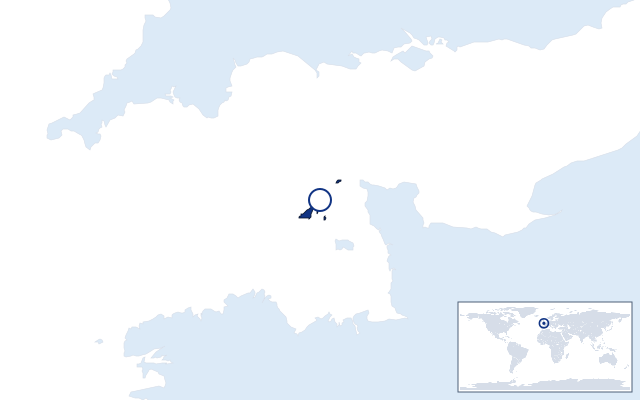
Fiduciary legislation and supervision
The Guernsey Financial Services Commission administers the licensing framework for regulated fiduciary business. Its sector guidance identifies the governing statute as The Regulation of Fiduciaries, Administration Businesses and Company Directors, etc. (Bailiwick of Guernsey) Law, 2020.[1]
The licensing rule covers regulated fiduciary activities conducted as a business in or from the Bailiwick of Guernsey. It also covers those activities when conducted by a company incorporated in the Bailiwick, with the Commission's licence providing the statutory authorization.[1]
Schedule 1 of the fiduciary legislation contains the minimum licensing criteria. The Commission describes these as continuing requirements, so meeting them is an obligation throughout the period an entity or individual holds a licence.[1]
Fiduciary licences and public records
The Commission describes three fiduciary licence categories, with different provisions for organizational and individual holders. Primary and secondary licences can be granted to a company, another legal person, or a partnership, while a personal licence is available only to an individual.[1]
- A primary licence authorizes the full range of regulated fiduciary activities described by the Commission.[1]
- A secondary licence also authorizes regulated fiduciary activities, but its holder cannot actively trade and serves the clients of its primary fiduciary licensee.[1]
- A personal licence permits a restricted range of activities, including acting as a trustee where the individual is not the sole trustee.[1]
The personal licence category also encompasses company directorships, estate administration, acting as executor of a will, and service as a foundation official.[1]
The Commission directs readers to its Regulated Entities resource for licensee details. It also describes a separate power under section 3(1)(ac) to grant limited permission to entities or individuals for strictly limited regulated fiduciary activities.[1]
CRS and FATCA reporting
Guernsey financial institutions report under the Common Reporting Standard, or CRS, and FATCA through the IGOR system. IGOR receives this information as XML reporting files.[3]
Guernsey's FATCA intergovernmental agreement is in force and follows Model 1.[3][4]
Treasury describes FATCA as requiring foreign financial institutions to report information about financial accounts held by U.S. taxpayers. Its description also includes accounts held by foreign entities in which U.S. taxpayers have a substantial ownership interest.[4]
IGOR accepts submissions through its web interface or through a web service using an organization API key. For FATCA submissions, each reporting financial institution needs a valid GIIN belonging to the organization's authorized financial institutions.[3]
For CRS submissions without a GIIN, IGOR authenticates the reporting institution by matching its name against the registered name. Both CRS and FATCA messages undergo validation against the applicable XML schema, including mandatory fields that IGOR itself may otherwise disregard.[3]
IGOR forwards account, account holder, and organization details to the destination country without processing those details. Under the Model 1 reporting arrangement, FATCA pooled reports are not permitted.[3]
U.S. tax and foreign trust reporting
A U.S. citizen falls within the IRS definition of a U.S. person for foreign trust reporting. The IRS explains that creating a foreign trust or transacting with one can produce both income tax consequences and information reporting requirements.[6]
Foreign trust classification and income
A trust is a foreign trust unless it meets the domestic trust definition. The same test applies for Form 3520 reporting. Domestic status requires both primary administrative supervision by a U.S. court and authority held by one or more U.S. persons over every substantial trust decision.[7]
Under the grantor trust rules, trust assets may be treated as belonging to a person other than the trust, including only part of its assets. The IRS generally taxes a U.S. person treated as a foreign trust's owner on the trust income attributable to that ownership.[6][7]
Section 679 generally treats a U.S. transferor as an owner when the foreign trust has, or is presumed to have, a U.S. beneficiary. A U.S. beneficiary receiving a foreign nongrantor trust distribution generally reports the beneficiary's share of distributable net income.[6]
Form 3520
Form 3520 reports specified foreign trust transactions and ownership under the grantor trust rules. The IRS generally identifies creation, transfers, loans, distributions, and uncompensated use of trust property among the events relevant to filing.[6]
The instructions require a separate Form 3520 for each foreign trust involved in reportable transactions. For an owner, Part II remains required even when the trust has had no transactions during the reporting period.[7]
A reportable distribution can include an indirect transfer, and the recipient need not be named as a beneficiary in the trust terms. Constructive distributions also count, including amounts a foreign trust pays for a person's credit card charges.[7]
The instructions provide exceptions for most fair market value transfers, while retaining reporting for specified categories within that group. Examples include transfers involving a related foreign trust and transfers made in exchange for obligations classified as qualified obligations.[7]
Form 3520-A and owner statements
A U.S. person treated as an owner has responsibility for ensuring that the foreign trust files a complete and accurate Form 3520-A on time. The trust also furnishes annual statements to its U.S. owners and beneficiaries.[6]
If the trust does not file Form 3520-A, the IRS requires the U.S. owner to attach a substitute return to a timely filed Form 3520. The substitute includes the owner and beneficiary statements, with copies provided to the U.S. owners and beneficiaries.[6][7]
The IRS specifies the foreign trust's employer identification number for Form 3520-A, in place of the owner's individual identifying number. Its Form 3520 instructions likewise distinguish individual identifiers from the EINs used for trusts and other entities.[6][7]
Form 8938, FBAR, and reporting exceptions
Form 8938 may be required when the total value of specified foreign financial assets in which a person has an interest exceeds the applicable reporting thresholds.
FBAR reporting may apply where a person has a financial interest in, or signature authority over, a foreign financial account. The IRS account examples include bank and brokerage accounts, mutual funds, and trusts, with reporting made on FinCEN Form 114.[6]
Specified exceptions to Forms 3520 and 3520-A cover certain qualifying retirement and other benefit trusts, subject to eligibility and trust requirements. The IRS expressly states that these exceptions leave other reporting obligations intact, including any applicable Form 8938 or FBAR requirement.[6]
Primary sources
The Internal Revenue Service publishes a foreign trust reporting overview and the instructions for Form 3520, which together cover the U.S. filing rules for foreign trusts.[4][6][7]
Guernsey trust law framework
Trust law framework
The Trusts (Guernsey) Law, 2007 governs Guernsey trusts.[8]
Under a trust, legal title to property is separated from the right to benefit from that property.[8] The settlor transfers legal title to a trustee to hold for beneficiaries or a purpose.[8]
Proper law of foreign trusts
Section 65(1) provides that, subject to subsection (2), a foreign trust is governed by and interpreted in accordance with its proper law.[9]
Trustee duties
Trustees must act prudently and in beneficiaries' interests, performing their duties honestly and in good faith.[8]
More on Guernsey
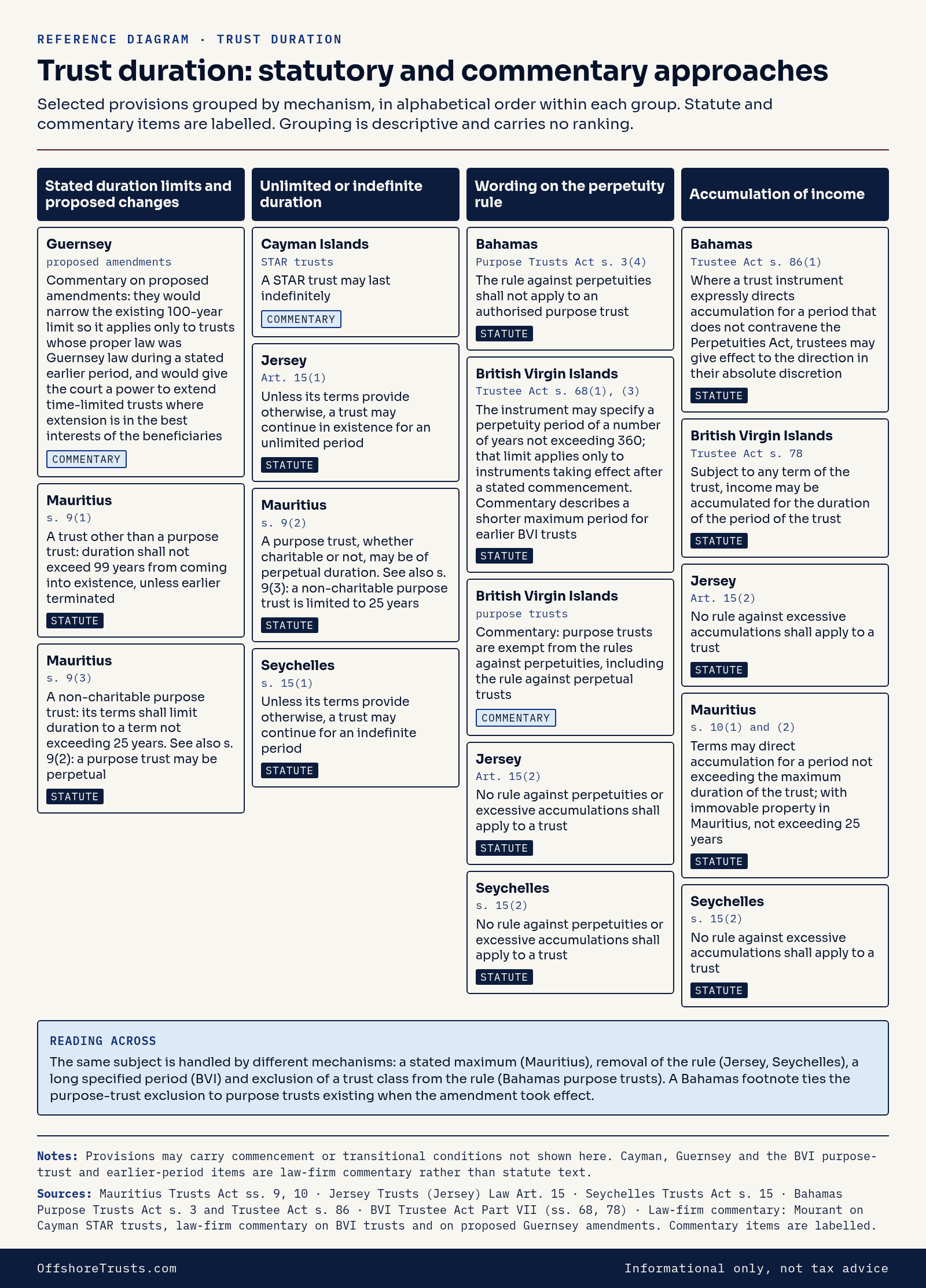
Data table for this infographic
| Mechanism | Jurisdiction | Provision or form | Description | Source type |
|---|---|---|---|---|
| Stated duration limits and proposed changes | Guernsey | proposed amendments | Commentary on proposed amendments: they would narrow the existing 100-year limit so it applies only to trusts whose proper law was Guernsey law during a stated earlier period, and would give the court a power to extend time-limited trusts where extension is in the best interests of the beneficiaries | commentary |
| Stated duration limits and proposed changes | Mauritius | s. 9(1) | A trust other than a purpose trust: duration shall not exceed 99 years from coming into existence, unless earlier terminated | statute |
| Unlimited or indefinite duration | Cayman Islands | STAR trusts | A STAR trust may last indefinitely | commentary |
| Unlimited or indefinite duration | Jersey | Art. 15(1) | Unless its terms provide otherwise, a trust may continue in existence for an unlimited period | statute |
| Unlimited or indefinite duration | Mauritius | s. 9(2) | A purpose trust, whether charitable or not, may be of perpetual duration (as amended in 2011) | statute |
| Unlimited or indefinite duration | Seychelles | s. 15(1) | Unless its terms provide otherwise, a trust may continue for an indefinite period | statute |
| Wording on the perpetuity rule | Bahamas | Purpose Trusts Act s. 3(4) | The rule against perpetuities shall not apply to an authorised purpose trust | statute |
| Wording on the perpetuity rule | British Virgin Islands | Trustee Act s. 68(1), (3) | The instrument may specify a perpetuity period of a number of years not exceeding 360; that limit applies only to instruments taking effect after a stated commencement. Commentary describes a shorter maximum period for earlier BVI trusts | statute |
| Wording on the perpetuity rule | British Virgin Islands | purpose trusts | Commentary: purpose trusts are exempt from the rules against perpetuities, including the rule against perpetual trusts | commentary |
| Wording on the perpetuity rule | Jersey | Art. 15(2) | No rule against perpetuities or excessive accumulations shall apply to a trust | statute |
| Wording on the perpetuity rule | Seychelles | s. 15(2) | No rule against perpetuities or excessive accumulations shall apply to a trust | statute |
| Accumulation of income | Bahamas | Trustee Act s. 86(1) | Where a trust instrument expressly directs accumulation for a period that does not contravene the Perpetuities Act, trustees may give effect to the direction in their absolute discretion | statute |
| Accumulation of income | British Virgin Islands | Trustee Act s. 78 | Subject to any term of the trust, income may be accumulated for the duration of the period of the trust | statute |
| Accumulation of income | Jersey | Art. 15(2) | No rule against excessive accumulations shall apply to a trust | statute |
| Accumulation of income | Mauritius | s. 10(1) and (2) | Terms may direct accumulation for a period not exceeding the maximum duration of the trust; with immovable property in Mauritius, not exceeding 25 years | statute |
| Accumulation of income | Seychelles | s. 15(2) | No rule against excessive accumulations shall apply to a trust | statute |
Reading across: The same subject is handled by different mechanisms: a stated maximum (Mauritius), removal of the rule (Jersey, Seychelles), a long specified period (BVI) and exclusion of a trust class from the rule (Bahamas purpose trusts). A Bahamas footnote ties the purpose-trust exclusion to purpose trusts existing when the amendment took effect.
Notes: Provisions may carry commencement or transitional conditions not shown here. Cayman, Guernsey and the BVI purpose-trust and earlier-period items are law-firm commentary rather than statute text.
Sources: Mauritius Trusts Act ss. 9, 10 · Jersey Trusts (Jersey) Law Art. 15 · Seychelles Trusts Act s. 15 · Bahamas Purpose Trusts Act s. 3 and Trustee Act s. 86 · BVI Trustee Act Part VII (ss. 68, 78) · Law-firm commentary: Mourant on Cayman STAR trusts, law-firm commentary on BVI trusts and on proposed Guernsey amendments. Commentary items are labelled.
Attribution: OffshoreTrusts.com
Questions and answers
Does U.S. citizenship bring me within these IRS reporting rules?
U.S. citizenship is included in the IRS definition of a U.S. person. Particular reporting requirements depend on the person's ownership, transactions, distributions, or other relevant connection with the foreign trust.[6]
Can a personal fiduciary licensee act as the only trustee?
No, a personal fiduciary licence does not permit acting as sole trustee. It permits trustee work within the restricted range of activities authorized by that licence.[1]
What FATCA agreement status does Treasury list for Guernsey?
Treasury lists Guernsey's agreement as in force under Model 1.
Does an absence of transactions remove an owner's Form 3520 reporting?
The instructions require Part II even when the trust has had no transactions during the reporting period. That part addresses U.S. ownership under the grantor trust rules.[7]
What happens if the foreign trust does not file Form 3520-A?
The IRS requires the U.S. owner to attach a substitute Form 3520-A to a timely filed Form 3520. Required owner and beneficiary statements accompany the substitute, and copies go to the U.S. owners and beneficiaries.[6][7]
Does a foreign trust reporting exception also remove Form 8938 or FBAR obligations?
The IRS says its specified foreign trust reporting exceptions do not change other reporting obligations. Form 8938 and FBAR remain relevant where their separate requirements apply.[6]
Related resources
Related glossary terms
- Section 6048: Section 6048 sets information reporting rules for certain foreign trusts. Its parts cover notice of events, U.S. owner duties and beneficiary distributions.
- FATCA: FATCA requires certain U.S. taxpayers to report foreign assets and financial institutions to report accounts to the IRS. Form 8938 may apply at thresholds.
- Foreign entity: Form 8938 instructions treat interests in foreign corporations and partnerships, and in trusts and estates, as specified foreign financial assets in some cases.
Related articles and guides
- Mauritius Trust Tax and Reporting Rules: Mauritius legislation on trusts and trustee residence, with the IRS guidance on foreign trust reporting by U.S. persons who own or benefit from such trusts.
- Cook Islands trust tax and reporting rules: Cook Islands trust legislation and revenue rules on tax information reporting, with the IRS reporting rules for a U.S. citizen with a Cook Islands trust.
- Bermuda reporting and U.S. foreign trust forms: Bermuda exchanges financial account information under CRS and FATCA. U.S. persons connected with foreign trusts there file the IRS forms for trust reporting.
Tools and official documents
- FinCEN Report 114 (FBAR): foreign account reporting: FinCEN Report 114 (FBAR) for U.S. citizens: account definitions, financial interests, signature authority, trust provisions and the filing requirements it sets.
- IRS form finder: Search form reference pages by keyword or number. Each result has a one-line description, and matches run across form titles and numbers, plus descriptions.
Sources and data notes
- Guernsey Financial Services Commission, Fiduciary. https://www.gfsc.gg/industry-sectors/fiduciary. Retrieved .
- Guernsey Financial Services Commission, Regulated Entities. https://www.gfsc.gg/industry-sectors/pensions/regulated-entities. Retrieved .
- States of Guernsey Revenue Service, IGOR XML Reporting Guide. https://igor.gov.gg/about/schemaguide. Retrieved .
- U.S. Department of the Treasury, Foreign Account Tax Compliance Act: agreements and understandings by jurisdiction. https://home.treasury.gov/policy-issues/tax-policy/foreign-account-tax-compliance-act. Retrieved .
- Internal Revenue Service, United States income tax treaties, A to Z. https://www.irs.gov/businesses/international-businesses/united-states-income-tax-treaties-a-to-z. Retrieved .
- Internal Revenue Service, Foreign trust reporting requirements and tax consequences. https://www.irs.gov/businesses/international-businesses/foreign-trust-reporting-requirements-and-tax-consequences. Retrieved .
- Internal Revenue Service, Instructions for Form 3520. https://www.irs.gov/instructions/i3520. Retrieved .
- mourant.com, Guernsey: Trusts, Mourant. https://www.mourant.com/guides/guernsey-trusts/. Retrieved .
- trusts.it, The Trusts (Guernsey) Law, 2007. https://trusts.it/admincp/UploadedPDF/200803181151540.sGuernseyTrustLaw2007.pdf. Retrieved .
Dates in this block record when each source was read for this page.