
Settlor
A settlor is a person who creates a trust or contributes property to it.
Meaning of settlor
The Hague Trusts Convention describes the settlor as the person who creates a trust relationship when assets are placed under a trustee's control for beneficiaries or a specified purpose.[1]
Jersey's Trusts Law gives a more direct definition: a settlor may provide trust property or make a testamentary disposition on trust. The Cayman Act uses a broader formulation for its special trust provisions, including people who directly or indirectly dispose of property for a trust, declare a trust, or otherwise create a trust.[3][4]
Where the term appears
The term settlor appears in more than one context. The Convention assigns the settlor a role in defining a trust and selecting its governing law, while local statutes address reserved powers and trustee records.[1]
Under the Convention, the settlor's law choice must be express or implied in the trust instrument or writing, interpreted in light of the circumstances if needed. If that chosen law does not recognize trusts or the relevant category, the choice is ineffective and a connection-based rule applies. Where no law was chosen, the governing law is the law most closely connected to the trust; the place of administration designated by the settlor is one factor.[1]
Relationship to trustee and beneficiary
The settlor and trustee have distinct roles in the Convention's definition. The settlor creates the legal relationship, while the trustee controls the assets and has duties to manage or dispose of them under the trust terms and law.[1]
A settlor can also retain certain rights or powers without that fact alone conflicting with the existence of a trust. The Jersey statute also states that a settlor or trustee may be a beneficiary, so these roles can overlap in a person.[1][3]
Reserved powers and records
The Cayman Act lists powers that may be reserved or granted to a settlor, including changing the trust instrument, appointing or removing trustees or beneficiaries, and directing trustee decisions about trust property. The Act says these powers do not invalidate the trust or affect its stated presumption of immediate effect.[4]
The Cayman Act separately identifies the settlor as one of the people whose identity and particulars a trustee must keep in an accurate record. It lists contributors, beneficiaries and protectors separately, so the settlor is a distinct record category in that provision.[4]
Local validity is a separate question from U.S. treatment. A statute that keeps a trust valid despite reserved powers does not decide the U.S. result. A power to revoke, direct distributions back to the settlor, or veto trustee decisions may affect the trust's U.S. tax classification and related reporting obligations. The legal effect of retained control depends on the governing law and the facts.
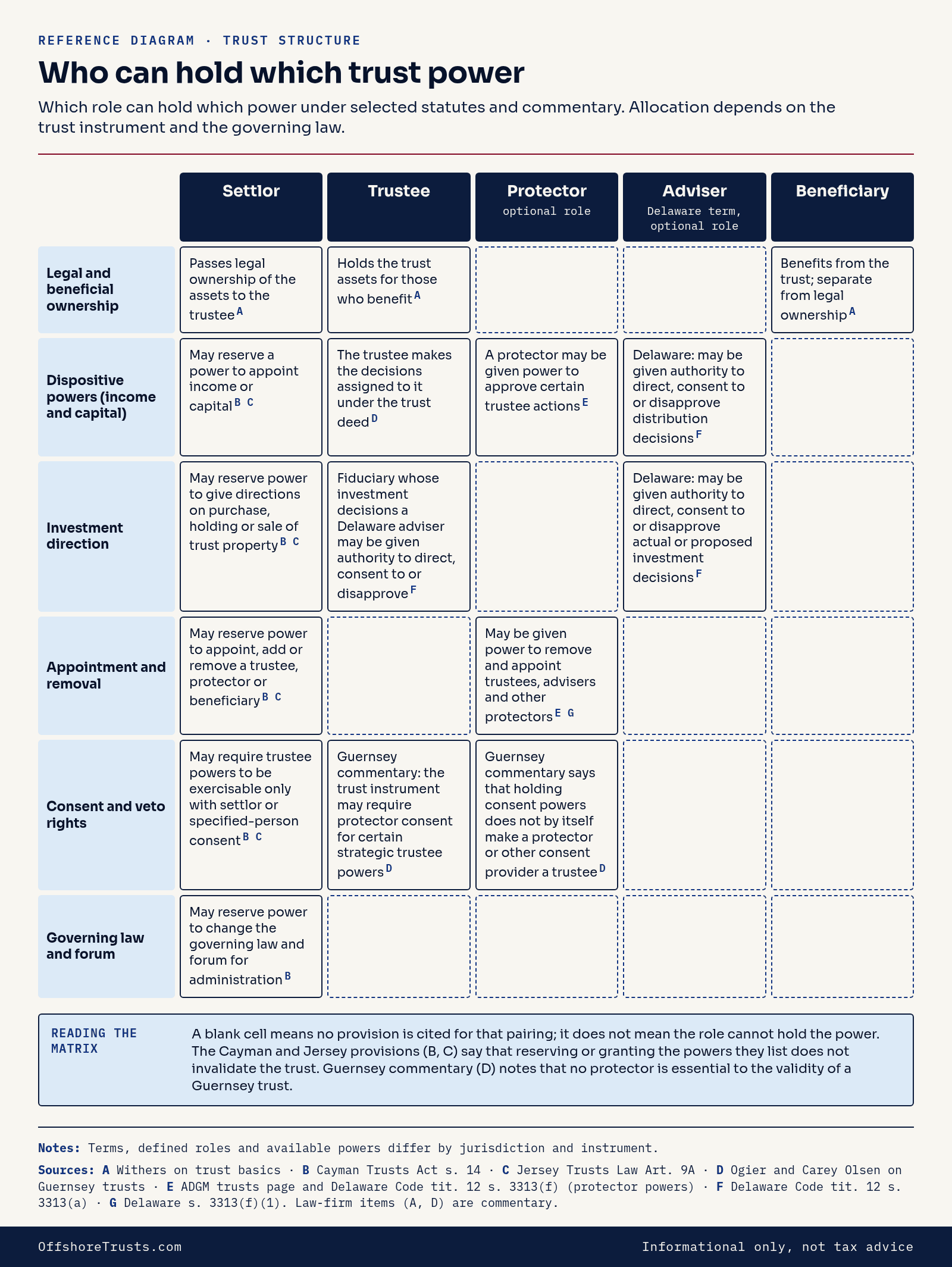
Data table for this infographic
| Power or topic | Settlor | Trustee | Protector | Investment adviser | Beneficiary |
|---|---|---|---|---|---|
| Legal and beneficial ownership | Passes legal ownership of the assets to the trustee A | Holds the trust assets for those who benefit A | Not covered | Not covered | Benefits from the trust; separate from legal ownership A |
| Dispositive powers (income and capital) | May reserve a power to appoint income or capital B C | The trustee makes the decisions assigned to it under the trust deed D | A protector may be given power to approve certain trustee actions E | Delaware: May be given authority to direct, consent to or disapprove distribution decisions F | Not covered |
| Investment direction | May reserve power to give directions on purchase, holding or sale of trust property B C | Fiduciary whose investment decisions a Delaware adviser may be given authority to direct, consent to or disapprove F | Not covered | Delaware: May be given authority to direct, consent to or disapprove actual or proposed investment decisions F | Not covered |
| Appointment and removal | May reserve power to appoint, add or remove a trustee, protector or beneficiary B C | Not covered | May be given power to remove and appoint trustees, advisers and other protectors E G | Not covered | Not covered |
| Consent and veto rights | May require trustee powers to be exercisable only with settlor or specified-person consent B C | Guernsey commentary: The trust instrument may require protector consent for certain strategic trustee powers D | Guernsey commentary says that holding consent powers does not by itself make a protector or other consent provider a trustee D | Not covered | Not covered |
| Governing law and forum | May reserve power to change the governing law and forum for administration B | Not covered | Not covered | Not covered | Not covered |
| Reading the matrix | A blank cell means no provision is cited for that pairing; it does not mean the role cannot hold the power. The Cayman and Jersey provisions (B, C) say that reserving or granting the powers they list does not invalidate the trust. Guernsey commentary (D) notes that no protector is essential to the validity of a Guernsey trust. Allocation depends on the trust instrument and the governing law. Terms, defined roles and available powers differ by jurisdiction and instrument. | ||||
| Notes and sources | Law-firm items (A, D) are commentary. A Withers on trust basics. B Cayman Trusts Act s. 14. C Jersey Trusts Law Art. 9A. D Ogier and Carey Olsen on Guernsey trusts. E ADGM trusts page and Delaware Code tit. 12 s. 3313(f) (protector powers). F Delaware Code tit. 12 s. 3313(a). G Delaware s. 3313(f)(1). | ||||
In more detail
The Convention describes the settlor's role through the placement of assets under a trustee's control for a beneficiary or a specified purpose. It also says the trust is governed by the law chosen by the settlor, with that choice expressed or implied in the trust instrument or writing that evidences the trust.[1]
The Convention says reserving certain rights or powers does not necessarily conflict with a trust's existence. Jersey law provides that a settlor's reservation or grant of a beneficial interest or specified powers does not by itself make the settlor or the recipient a trustee.[1][3]
Key points
A trust instrument may reserve or grant the settlor powers over investments or the ability to revoke, vary, or amend trust terms.[6]
A settlor may be named as a beneficiary under the trust's terms.[7]
A settlor may be involved as a protector or hold reserved powers while a private trust company serves as trustee.[8]
Related reading
Related terms include trust, trust instrument, trustee, and beneficiary.
Questions and answers
Does a settlor have to be the trustee?
The Convention describes the settlor and trustee as separate roles in its trust definition. The Cayman Act also contemplates that a settlor may be one of the trustees.[1][4]
Can a settlor also be a beneficiary?
Yes. Jersey's Trusts Law states that a settlor or trustee may also be a beneficiary of the trust.[3]
Can the settlor retain powers over a trust?
The Convention says reserving certain rights and powers is not necessarily inconsistent with a trust. The Cayman Act lists powers such as changing trust terms, appointing trustees, or giving directions, and says such reservations do not by themselves invalidate the trust.[1][4]
How can a settlor affect the governing law?
The Convention says a trust is governed by the law chosen by the settlor, with the choice stated or implied in the trust instrument or writing. If no law is chosen, the law most closely connected to the trust applies under the Convention's rule.[1]
Is a settlor the same as a contributor?
The Cayman Act lists a settlor and a contributor as separate categories for trustee recordkeeping. The Jersey definition focuses on providing trust property or making a testamentary disposition, while the Cayman definition for a particular part of the Act also covers declaring or otherwise creating a trust.[3][4]
Related terms
- Trust: The Hague Convention describes a trust as a relationship in which a settlor places assets under a trustee's control for beneficiaries or a specified purpose.
- Reserved powers: Reserved powers are rights a settlor keeps, or gives to another person, under a trust. Trust laws address their validity and timing, and administration.
- Trust instrument: The Hague Trusts Convention describes a trust instrument as a document that creates a trust or writing that evidences it. It also describes trust terms.
- Proper law of a trust: The Jersey Trusts Law defines proper law as the jurisdiction's law expressed or implied in trust terms, or most closely connected to the trust when created.
Related guides and articles
- Settlor, trustee and beneficiary roles: Trust structure and the roles of settlors and of trustees, and of beneficiaries, tied to the IRS instructions for Form 3520 that apply to U.S. citizens.
- What a trust means under U.S. and international law: Trust terms and structure, the Hague Convention's rules, and U.S. tax classification and limited reporting rules, all explained plainly for U.S. citizens.
- Reserved Powers in Trust Instruments: Trust instruments may reserve powers to a settlor or grant them to others, while listed statutes address their validity and whether a holder becomes a trustee.
Related pages
- Glossary: All terms.
- Discretionary trust
- Enforcer
- IRS forms
Sources and data notes
- HCCH, 1985 Hague Trusts Convention. https://www.hcch.net/en/instruments/conventions/full-text/?cid=59. Retrieved .
- Internal Revenue Service, 26 CFR 301.7701-4. https://www.ecfr.gov/current/title-26/section-301.7701-4. Retrieved .
- Jersey Legal Information Board, Trusts (Jersey) Law 1984. https://jerseylaw.je/laws/current/l_11_1984. Retrieved .
- Cayman Islands Legislature, Trusts Act (2021 Revision). https://legislation.gov.ky/cms/images/LEGISLATION/PRINCIPAL/1967/1967-0006/1967-0006_2021%20Revision.pdf. Retrieved .
- Legislature of Bermuda, Trusts (Special Provisions) Act 1989. https://bermuda.fm/legislation/1591. Retrieved .
- ogier.com, The use of trusts in Jersey | Ogier. https://www.ogier.com/news-and-insights/insights/the-use-of-trusts-in-jersey/. Retrieved .
- careyolsen.com, Types and uses of Cayman Islands law trusts | Carey Olsen. https://www.careyolsen.com/insights/briefings/types-and-uses-cayman-islands-law-trusts. Retrieved .
- careyolsen.com, Cayman Islands private trust companies | Carey Olsen. https://www.careyolsen.com/insights/briefings/cayman-islands-private-trust-companies. Retrieved .
Dates in this block record when each source was read for this page.