
What a trust means under U.S. and international law
Trust terms and structure, the Hague Convention's rules, and U.S. tax classification and limited reporting rules, all explained plainly for U.S. citizens.
What a trust means
The Hague Convention defines a trust through legal relationships involving a settlor, assets, and a trustee. The settlor creates those relationships by placing assets under a trustee's control for beneficiaries or a stated purpose. The definition covers creation during the settlor's lifetime or at death.[1]
For Internal Revenue Code purposes, the regulation describes an ordinary trust as an arrangement established through a will or a declaration during life. Trustees take title to property to conserve it for beneficiaries. The regulation connects trust classification to the arrangement's purpose and the responsibilities assigned to trustees.[2]
Who holds each role
The settlor creates the trust relationships, while the trustee controls and administers the assets under the Convention's definition. A beneficiary is a person for whose benefit the assets are held, although the definition also permits a specified purpose.[1]
These roles can overlap under the Convention. A settlor's retention of certain powers, or a trustee's rights as a beneficiary, does not necessarily prevent a trust from existing.[1]
The U.S. regulation also allows beneficiaries to create an ordinary trust. Recognition under that provision depends on its conservation purpose and on beneficiaries having the same relationship to it as beneficiaries of a trust created by someone else.[2]
How trust property is held and managed
Under the Convention, trust assets form a fund separate from the trustee's own estate. Title can be held in the trustee's name or in another person's name on the trustee's behalf. Control, title, and the benefit of the property therefore have distinct roles within the definition.[1]
The trustee has both authority and responsibility for managing, using, or disposing of the property. The trust terms and duties imposed by law govern that work, and the trustee is accountable for it. The definition therefore includes obligations alongside the power to act.[1]
Which law governs a trust
The Convention starts with the settlor's choice of governing law. That choice can be stated expressly or inferred from the document creating or evidencing the trust, interpreted in light of the circumstances when necessary.[1]
A choice is ineffective if the selected law does not provide for trusts or the relevant trust category. Without an applicable choice, the Convention uses the law having the closest connection to the trust.[1]
The connection factors include the designated place of administration, asset locations, the trustee's residence or business location, and the trust's objectives and where they are carried out.[1]
What governing law covers
The law identified under the Convention governs trust validity, interpretation, effects, and administration. Its scope includes trustee appointments and departures, investment powers, distributions, and the obligation to account for administration.[1]
A separable part of a trust, especially administration, may be governed by another law. Whether the applicable law can be replaced is itself determined by the law governing the trust's validity.[1]
The Convention's basic scope covers voluntarily created trusts evidenced in writing. It excludes preliminary questions about the validity of wills and other acts transferring assets to trustees, and it leaves states' fiscal powers intact.[1]
How U.S. tax classification treats the arrangement
A trust label does not determine classification under the Internal Revenue Code. The regulation distinguishes ordinary trusts from arrangements organized to operate a business for profit, even when trustees hold title for beneficiaries.[2]
An investment trust with one class of undivided beneficial interests qualifies as a trust if its agreement gives no power to vary certificate holders' investments. Multiple classes ordinarily lead to business-entity classification, subject to the regulation's exception for direct investment with incidental multiple classes and no investment-variation power.[2]
Why a trust is not a legal entity
A trust is a legal relationship, not a separate legal entity. The trustee holds title to the assets, in the trustee's own name or in another person's name on the trustee's behalf, and the assets form a fund separate from the trustee's own estate.[1]
A trust label does not decide how the arrangement is classified for U.S. tax purposes, which depends on whether it is an ordinary trust or a business arrangement under the regulation.[2]
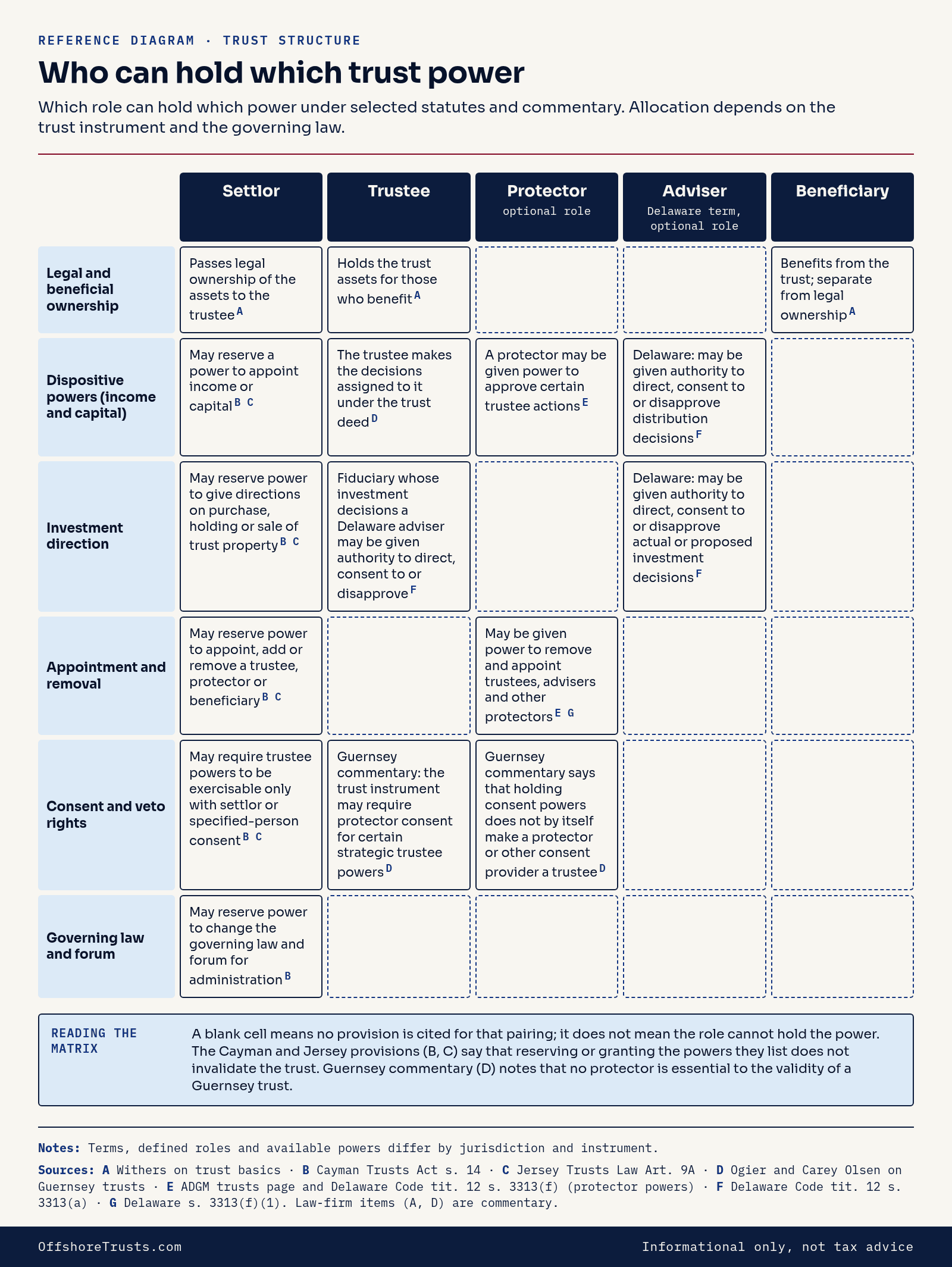
Data table for this infographic
| Power or topic | Settlor | Trustee | Protector | Investment adviser | Beneficiary |
|---|---|---|---|---|---|
| Legal and beneficial ownership | Passes legal ownership of the assets to the trustee A | Holds the trust assets for those who benefit A | Not covered | Not covered | Benefits from the trust; separate from legal ownership A |
| Dispositive powers (income and capital) | May reserve a power to appoint income or capital B C | The trustee makes the decisions assigned to it under the trust deed D | A protector may be given power to approve certain trustee actions E | Delaware: May be given authority to direct, consent to or disapprove distribution decisions F | Not covered |
| Investment direction | May reserve power to give directions on purchase, holding or sale of trust property B C | Fiduciary whose investment decisions a Delaware adviser may be given authority to direct, consent to or disapprove F | Not covered | Delaware: May be given authority to direct, consent to or disapprove actual or proposed investment decisions F | Not covered |
| Appointment and removal | May reserve power to appoint, add or remove a trustee, protector or beneficiary B C | Not covered | May be given power to remove and appoint trustees, advisers and other protectors E G | Not covered | Not covered |
| Consent and veto rights | May require trustee powers to be exercisable only with settlor or specified-person consent B C | Guernsey commentary: The trust instrument may require protector consent for certain strategic trustee powers D | Guernsey: Holding consent powers does not by itself make a protector or other consent provider a trustee D | Not covered | Not covered |
| Governing law and forum | May reserve power to change the governing law and forum for administration B | Not covered | Not covered | Not covered | Not covered |
| Reading the matrix | "Not covered" means no provision is listed for that pairing; it does not mean the role cannot hold the power. Under Cayman and Jersey law (B, C), reserving or granting the listed powers does not invalidate the trust. No protector is essential to the validity of a Guernsey trust (D). Allocation depends on the trust instrument and the governing law. Terms, defined roles and available powers differ by jurisdiction and instrument. | ||||
| Notes and sources | Law-firm items (A, D) are commentary. A Withers on trust basics. B Cayman Trusts Act s. 14. C Jersey Trusts Law Art. 9A. D Ogier and Carey Olsen on Guernsey trusts. E ADGM trusts page and Delaware Code tit. 12 s. 3313(f) (protector powers). F Delaware Code tit. 12 s. 3313(a). G Delaware s. 3313(f)(1). | ||||
Questions and answers
Does a trust have to benefit a named person?
The Convention's definition permits assets to be held for a beneficiary or a specified purpose. Its scope is limited to trusts created voluntarily and evidenced in writing.[1]
Can the person creating a trust also receive benefits?
The U.S. regulation permits beneficiaries to create an ordinary trust. Its recognition condition concerns the conservation purpose and the beneficiaries' relationship to the arrangement.[2]
Does choosing a governing law always settle the question?
The Convention makes a choice ineffective when that law does not provide for trusts or the relevant category. The closest-connection rule then supplies the governing law.[1]
Does calling an arrangement a trust establish its U.S. tax classification?
The regulation treats the arrangement's actual character as relevant despite its trust form. An organization may be classified as a business entity even though trustees hold property for beneficiaries.[2]
Related resources
Related glossary terms
- Proper law of a trust: The Jersey Trusts Law defines proper law as the jurisdiction's law expressed or implied in trust terms, or most closely connected to the trust when created.
- Trustee: A trustee controls trust assets and manages, uses, or disposes of them for beneficiaries or a stated purpose under the trust terms and applicable law.
- Recognition of a trust: The Hague Convention describes recognition of a trust, its minimum legal effects, and limits tied to applicable law. Jersey law also addresses recognition.
Related articles and guides
- The Hague Trusts Convention explained: The Hague Trusts Convention addresses which law governs a trust and how a trust is recognized, while preserving each state's fiscal powers over trusts and tax.
- How the IRS classifies trusts for U.S. tax purposes: U.S. trust classification for tax purposes: ordinary and investment trusts, U.S. person status, and the environmental remediation trust rule in the regulations.
- 26 CFR § 301.7701-4, Trusts: 26 CFR § 301.7701-4 covers arrangements treated as trusts for U.S. federal tax purposes, including investment trusts and environmental remediation trusts.
Tools and official documents
- Foreign trust reporting role finder: Tick the roles that describe a connection to a foreign trust or foreign account to see the forms the IRS and FinCEN instructions discuss. Roles can overlap.
Related pages
Sources and data notes
- Hague Conference on Private International Law, Convention of 1 July 1985 on the Law Applicable to Trusts and on their Recognition. https://www.hcch.net/en/instruments/conventions/full-text/?cid=59. Retrieved .
- U.S. Department of the Treasury; Office of the Federal Register, 26 CFR § 301.7701-4, Trusts. https://www.ecfr.gov/current/title-26/section-301.7701-4. Retrieved .
Dates in this block record when each source was read for this page.