

Trust types and statutory regimes in The Bahamas
The Bahamas Trustee Act and Purpose Trusts Act set out rules for express trusts and authorised purpose trusts, including duration and income.
Express and purpose trusts
The Trustee Act refers to express trusts and addresses discretionary trusts, while the Purpose Trusts Act establishes a separate regime for authorised purpose trusts. Under that Act, an instrument may declare a trust for a non-charitable purpose, including holding or investing in company shares or other trust assets, if the stated conditions are met.[2]
The purpose must be possible and sufficiently certain for the trust to be carried out. It also cannot be contrary to public policy or unlawful under Bahamian law. The instrument must specify a termination event and provide for distribution of surplus trust assets when termination occurs.[1]
The Act permits an authorised purpose trust to hold capital or income subject to fixed interests, discretionary interests, or a combination of both. The capital or income may be directed to persons, purposes that are charitable or non-charitable, or a combination of persons and purposes.[1]
The Act states that an authorised purpose trust meeting its requirements is not regarded as a charitable trust or an ordinary trust when its instrument identifies it as an authorised purpose trust. The statute also states that the rule against perpetuities does not apply to this statutory trust type.[1]
Trustees and administration
For an authorised purpose trust, a person carrying out trust business in or from The Bahamas may act as trustee only if it is a licensed bank or trust company, or an individual licensed as a service provider under the named Bahamian statute. Trustees administering the trust keep specified records in The Bahamas.[1]
Those records include the trust instrument and later written instruments, a register naming the creator and summarizing the purpose or purposes, and documents sufficient to show the trust's financial position.[1]
Where an authorised purpose trust has multiple purposes, its instrument may set out how capital or income is allocated. Unless the instrument expresses a contrary intention, trustees have discretion to allocate capital and income among purposes and determine methods for pursuing them, subject to the instrument's terms.[1]
For express trusts, the Trustee Act requires a trustee to maintain records concerning money received and spent, transactions, and trust assets and liabilities. The records must explain transactions, support reasonable accuracy in determining financial position, enable preparation of financial statements, and include necessary underlying documents.[2]
The Trustee Act also states that powers for trustees, settlors, protectors, or others to add beneficiaries or appoint property among a class, as well as discretionary trusts, are not invalid solely because the potential beneficiaries cannot all be identified with certainty or the class is unlimited.[2]
Reserved powers and beneficiary interests
The Trustee Act lists powers that may be retained by a settlor without invalidating the trust or trust instrument under that provision. They include revocation, withdrawal of property, appointment or disposition powers over trust property, and powers to amend the trust instrument.[2]
The listed matters also include powers to appoint, add, or remove trustees, protectors, or beneficiaries, powers to direct trustees in exercising powers or discretions, and requirements for settlor consent to trustee action or inaction. The section also lists a settlor serving as protector or holding beneficial interests in trust capital or income.[2]
Subject to contrary wording and the instrument's other terms, a power to amend, alter, or vary a trust includes authority to add beneficiaries, including the settlor or private or charitable trusts, and to remove beneficiaries. The same provision allows extension of the instrument's perpetuity period to a maximum of 150 years calculated from the date of the instrument.[2]
Bahamas legislation settles whether a trust stays valid when the settlor keeps powers. It does not settle the U.S. result. A power to revoke, to direct distributions back to the settlor, or to veto trustee decisions can make the trust a grantor trust under sections 671 to 679, so the settlor reports the trust's income and the foreign trust forms. The legal effect of retained control depends on the governing law and the facts.
Duration and accumulation
The Purpose Trusts Act requires the trust instrument for an authorised purpose trust to state a termination event and direct the disposition of surplus assets on termination. The rule against perpetuities does not apply to an authorised purpose trust, while the Trustee Act separately addresses extension of a perpetuity period specified in a trust instrument.[1][2]
The Trustee Act addresses accumulation where a trust instrument expressly directs income to be accumulated for a period that does not contravene the Perpetuities Act. In that circumstance, trustees may, in their absolute discretion, give effect to the direction despite a beneficiary demand for distribution, subject to the instrument's terms and any contrary intention in it.[2]
The same accumulation provision states that beneficiaries cannot vary the trusts to remove or modify the discretion it gives trustees. It applies only so far as the trust instrument expresses no contrary intention and remains subject to the instrument's terms.[2]
The Bahamas Trustee Act and trust legislation
The Trustee Act, Chapter 176, addresses the law of trustees and connected purposes in The Bahamas. Part I covers the short title and interpretation, then powers retained, possessed or acquired by a settlor. The separate Purpose Trusts Act, Chapter 176A, applies ordinary trust law, including the Trustee Act, unless it provides otherwise.[2]
The Trustee Act has seven Parts and two Schedules. Part I contains section 2 definitions. Part II addresses investments. Part III covers general powers of trustees and personal representatives, with subdivisions for general powers and indemnities. It includes maintenance and advancement, plus protective trusts. Part IV concerns trustee appointment and discharge; Part V addresses court powers. Part VI contains special provisions, while Part VII addresses fiscal and regulatory matters.[2]
Section 2 defines authorised investments and Court; income and land; property and protector; securities and stock. Trust includes implied and constructive trusts, together with resulting trusts and certain duties connected with personal representatives. A trust instrument includes an instrument creating a trust or an oral declaration where no instrument created it.[2]
Investment provisions address investment powers and advice, retention of investments and supplementary powers. Part III addresses land and receipts and insurance, along with agents, and delegation. It covers applying income and capital for maintenance or advancement. Application depends on the section and trust terms. Special provisions address majority action and protectors, directed trusts and managing trustees, trust records and arbitration of trust disputes. Part VII covers trust duty and trustee accounting records and tax, along with registration, exchange control exemptions, and application and savings provisions.[2]
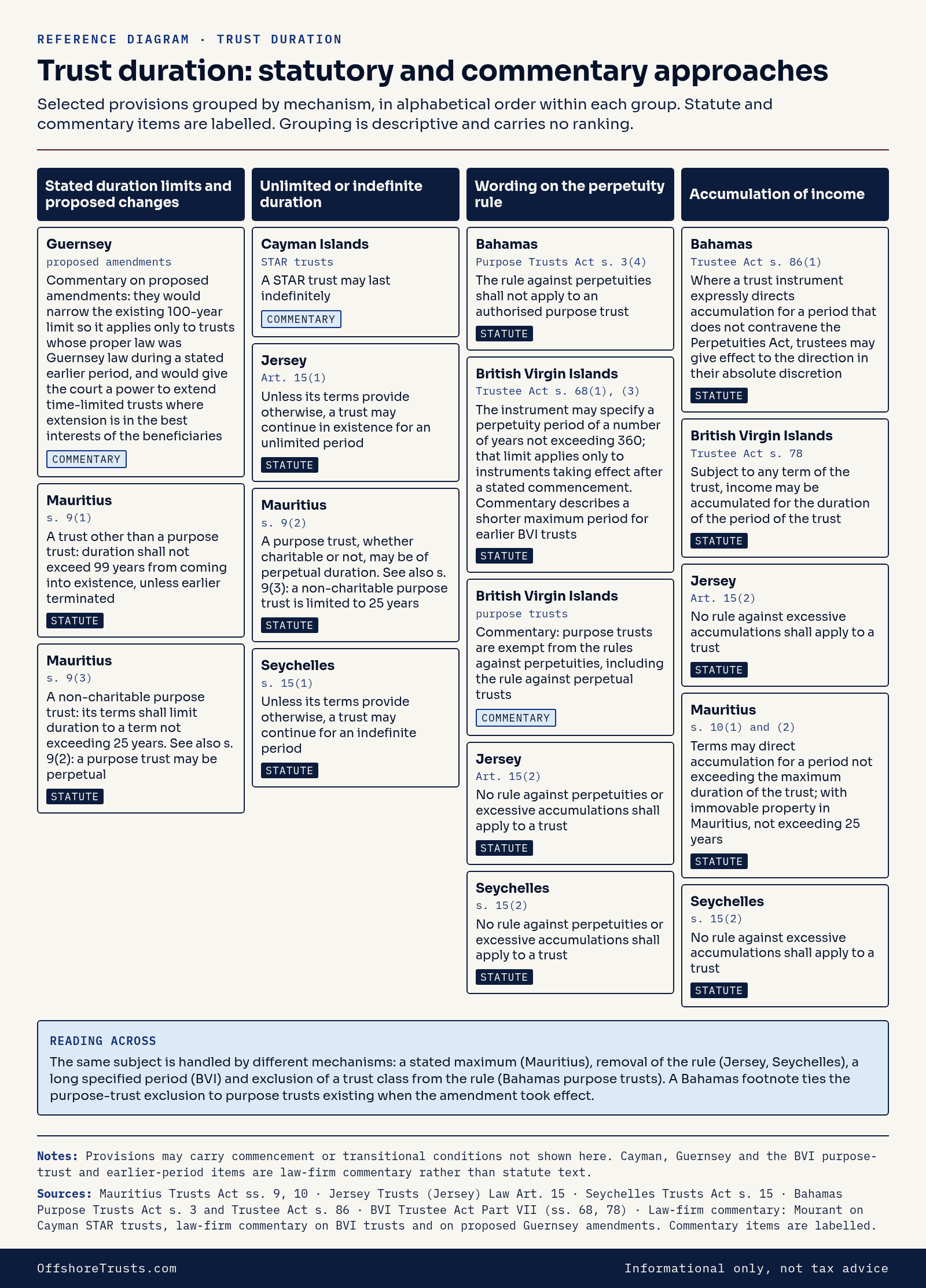
Data table for this infographic
| Mechanism | Jurisdiction | Provision or form | Description | Source type |
|---|---|---|---|---|
| Stated duration limits and proposed changes | Guernsey | proposed amendments | Commentary on proposed amendments: they would narrow the existing 100-year limit so it applies only to trusts whose proper law was Guernsey law during a stated earlier period, and would give the court a power to extend time-limited trusts where extension is in the best interests of the beneficiaries | commentary |
| Stated duration limits and proposed changes | Mauritius | s. 9(1) | A trust other than a purpose trust: duration shall not exceed 99 years from coming into existence, unless earlier terminated | statute |
| Unlimited or indefinite duration | Cayman Islands | STAR trusts | A STAR trust may last indefinitely | commentary |
| Unlimited or indefinite duration | Jersey | Art. 15(1) | Unless its terms provide otherwise, a trust may continue in existence for an unlimited period | statute |
| Unlimited or indefinite duration | Mauritius | s. 9(2) | A purpose trust, whether charitable or not, may be of perpetual duration (as amended in 2011) | statute |
| Unlimited or indefinite duration | Seychelles | s. 15(1) | Unless its terms provide otherwise, a trust may continue for an indefinite period | statute |
| Wording on the perpetuity rule | Bahamas | Purpose Trusts Act s. 3(4) | The rule against perpetuities shall not apply to an authorised purpose trust | statute |
| Wording on the perpetuity rule | British Virgin Islands | Trustee Act s. 68(1), (3) | The instrument may specify a perpetuity period of a number of years not exceeding 360; that limit applies only to instruments taking effect after a stated commencement. Commentary describes a shorter maximum period for earlier BVI trusts | statute |
| Wording on the perpetuity rule | British Virgin Islands | purpose trusts | Commentary: purpose trusts are exempt from the rules against perpetuities, including the rule against perpetual trusts | commentary |
| Wording on the perpetuity rule | Jersey | Art. 15(2) | No rule against perpetuities or excessive accumulations shall apply to a trust | statute |
| Wording on the perpetuity rule | Seychelles | s. 15(2) | No rule against perpetuities or excessive accumulations shall apply to a trust | statute |
| Accumulation of income | Bahamas | Trustee Act s. 86(1) | Where a trust instrument expressly directs accumulation for a period that does not contravene the Perpetuities Act, trustees may give effect to the direction in their absolute discretion | statute |
| Accumulation of income | British Virgin Islands | Trustee Act s. 78 | Subject to any term of the trust, income may be accumulated for the duration of the period of the trust | statute |
| Accumulation of income | Jersey | Art. 15(2) | No rule against excessive accumulations shall apply to a trust | statute |
| Accumulation of income | Mauritius | s. 10(1) and (2) | Terms may direct accumulation for a period not exceeding the maximum duration of the trust; with immovable property in Mauritius, not exceeding 25 years | statute |
| Accumulation of income | Seychelles | s. 15(2) | No rule against excessive accumulations shall apply to a trust | statute |
Reading across: The same subject is handled by different mechanisms: a stated maximum (Mauritius), removal of the rule (Jersey, Seychelles), a long specified period (BVI) and exclusion of a trust class from the rule (Bahamas purpose trusts). In The Bahamas, the purpose-trust exclusion is tied to purpose trusts existing when the amendment took effect.
Notes: Provisions may carry commencement or transitional conditions not shown here. The Cayman STAR trust item, the Guernsey proposed amendments item and the BVI purpose trust item are law-firm commentary and not statute text.
Sources: Mauritius Trusts Act ss. 9, 10 · Jersey Trusts (Jersey) Law Art. 15 · Seychelles Trusts Act s. 15 · Bahamas Purpose Trusts Act s. 3 and Trustee Act s. 86 · BVI Trustee Act Part VII (ss. 68, 78) · Law-firm commentary: Mourant on Cayman STAR trusts, law-firm commentary on BVI trusts and on proposed Guernsey amendments. Commentary items are labelled.
Attribution: OffshoreTrusts.com
Questions and answers
Can a Bahamian statutory purpose trust support charitable purposes?
Yes. The Purpose Trusts Act allows authorised purpose trust capital or income to be applied for purposes that may be charitable or non-charitable. It also permits a combination of persons and purposes.[1]
Does the rule against perpetuities apply to an authorised purpose trust?
The Purpose Trusts Act states that the rule against perpetuities does not apply to an authorised purpose trust. The trust instrument still specifies a termination event and provides for surplus assets upon termination.[1]
What kinds of powers can a settlor retain under the Trustee Act?
The listed powers include revocation, withdrawal of property, appointment or disposition over trust property, and amendment powers. The provision also lists powers concerning trustees, protectors, beneficiaries, directions, and settlor consent.[2]
When can trustees continue an income accumulation?
The Trustee Act addresses an express direction to accumulate income for a period that does not contravene the Perpetuities Act. In that situation, trustees may exercise the statutory discretion to give effect to the direction, subject to the trust instrument.[2]
Related resources
Related glossary terms
- Trust: The Hague Convention describes a trust as a relationship in which a settlor places assets under a trustee's control for beneficiaries or a specified purpose.
- Reserved powers: Reserved powers are rights a settlor keeps, or gives to another person, under a trust. Trust laws address their validity and timing, and administration.
- Settlor: A settlor is the person who creates a trust or transfers property into it.
Related articles and guides
- Trust types and duration under Seychelles law: Seychelles law recognizes beneficiary and purpose trusts, with rules on trustees and settlors and on trust duration, set out by statute for each trust type.
- The Bahamas court and legal system structure: The courts of The Bahamas range from the Magistrates Court and Supreme Court to the Court of Appeal, with a final appeal to the Privy Council in London.
Related pages
- Bahamas: overview: Start page for this jurisdiction.
- Trustee regulation and licensing
- Taxation of trusts
- Reporting and information exchange
Sources and data notes
- Statute Law of The Bahamas, Purpose Trusts Act. https://laws.bahamas.gov.bs/cms/images/LEGISLATION/PRINCIPAL/2004/2004-0017/2004-0017.pdf. Retrieved .
- Government of The Bahamas, Trustee. https://laws.bahamas.gov.bs/cms/images/LEGISLATION/PRINCIPAL/1998/1998-0022/1998-0022.pdf. Retrieved .
- The Bahamas On-line Legislation, by Category. https://laws.bahamas.gov.bs/cms/legislation/index/by-category.html. Retrieved .
Dates in this block record when each source was read for this page.