
FBAR Filing Dates and Submission
For a U.S. citizen, the FBAR is an annual report with a due date tied to the calendar year being reported.
Annual due date
The FBAR for a calendar year is due by April 15 of the following year. It is an annual report. The relevant reporting period is the calendar year being reported, so the due date follows that period.[1][4]
Before the 2016 reporting year, FBARs for each calendar year were due by June 30 of the following year.
Automatic extension
FinCEN grants an automatic extension to October 15 for filers who miss the April 15 annual due date. A filer does not need to request this extension.[1][4]
The extension does not change the stated annual due date. April 15 remains the due date, and October 15 is the automatic extension date for filers who miss it.
Electronic filing and the tax return
The FBAR is submitted electronically through FinCEN's BSA E-Filing System. An FBAR is not filed with a federal tax return.[1][4]
The reason the filing is separate is that the FBAR is a report, not a tax return. It reports to the Secretary of the Treasury a person's financial interest in, or signature authority over, foreign financial accounts. The filing requirement applies when the aggregate value of those accounts exceeds $10,000 at any time during the calendar year.
An FBAR is not attached to Form 1040. Its due date and electronic submission method are separate from the federal income tax return process.[1][2]
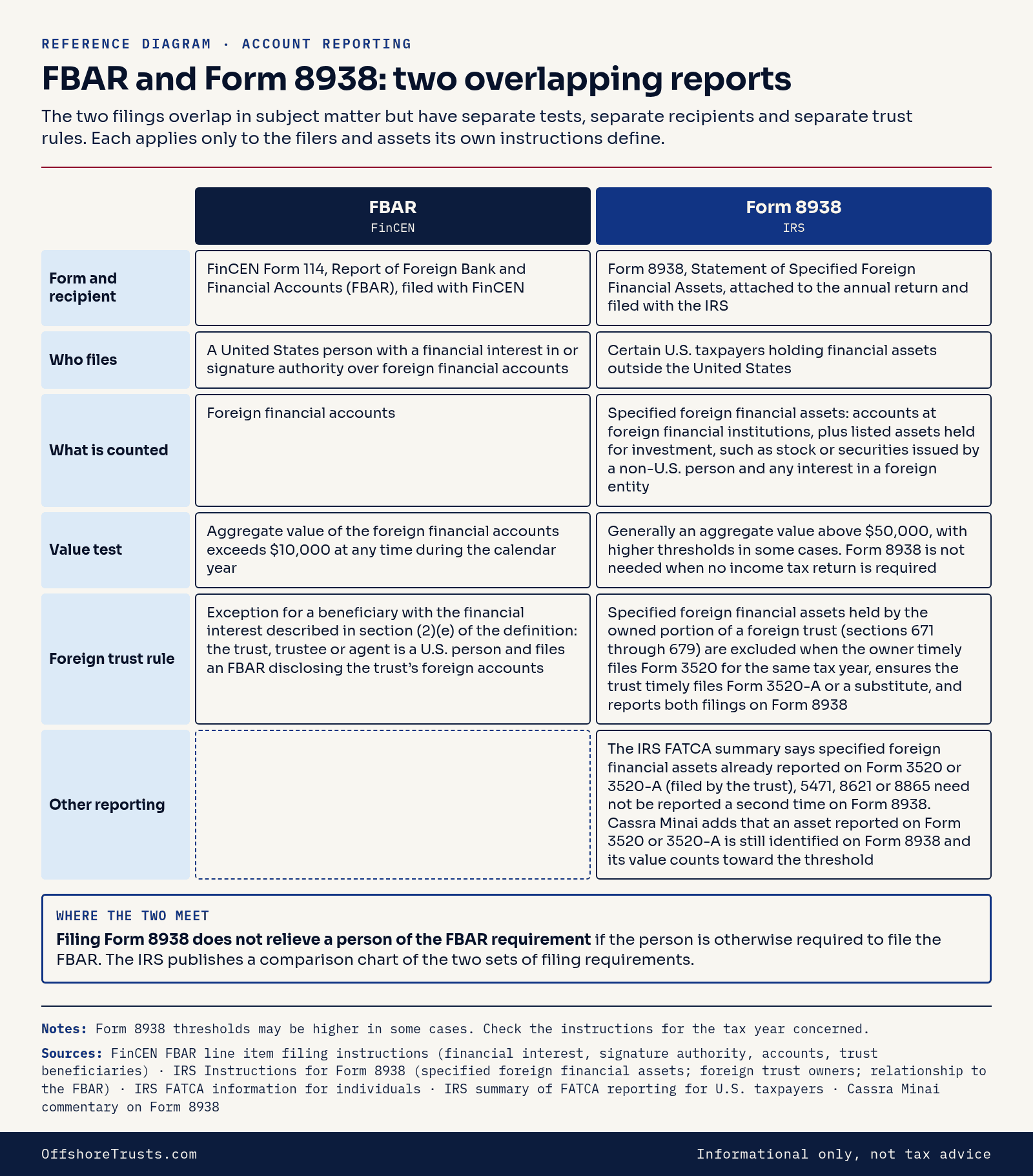
Data table for this infographic
| Topic | FBAR | Form 8938 |
|---|---|---|
| Summary | The two filings overlap in subject matter but have separate tests, separate recipients and separate trust rules. | |
| Form and recipient | FinCEN Form 114, Report of Foreign Bank and Financial Accounts (FBAR), filed with FinCEN | Form 8938, Statement of Specified Foreign Financial Assets, attached to the annual return and filed with the IRS |
| Who files | A United States person with a financial interest in or signature authority over foreign financial accounts | Certain U.S. taxpayers holding financial assets outside the United States |
| What is counted | Foreign financial accounts | Specified foreign financial assets: accounts at foreign financial institutions, plus listed assets held for investment, such as stock or securities issued by a non-U.S. person and any interest in a foreign entity |
| Value test | Aggregate value of the foreign financial accounts exceeds $10,000 at any time during the calendar year | Generally an aggregate value above $50,000, with higher thresholds in some cases. Form 8938 is not needed when no income tax return is required |
| Foreign trust rule | Exception for a beneficiary whose financial interest in a trust account rests on a present beneficial interest in more than 50 percent of the trust assets or current income: no filing is needed when the trust, trustee or agent is a U.S. person and files an FBAR disclosing the trust's foreign accounts | Specified foreign financial assets held by the owned portion of a foreign trust (sections 671 through 679) are excluded when the owner timely files Form 3520 for the same tax year, ensures the trust timely files Form 3520-A or a substitute, and reports both filings on Form 8938 |
| Other reporting | Specified foreign financial assets already reported on Form 3520 or 3520-A (filed by the trust), 5471, 8621 or 8865 need not be reported a second time on Form 8938. Form 8938 still shows which of those forms were filed and how many, and the asset's value counts toward the threshold. | |
| Where the two meet | Filing Form 8938 does not relieve a person of the FBAR requirement if the person is otherwise required to file the FBAR. The IRS publishes a comparison chart of the two sets of filing requirements. | |
| Notes | Form 8938 thresholds may be higher in some cases. The instructions for the tax year concerned govern. | |
| Sources | FinCEN FBAR line item filing instructions (financial interest, signature authority, accounts, trust beneficiaries) · IRS Instructions for Form 8938 (specified foreign financial assets; foreign trust owners; relationship to the FBAR) · IRS FATCA information for individuals · IRS summary of FATCA reporting for U.S. taxpayers · Cassra Minai commentary on Form 8938 | |
Questions and answers
When is an FBAR due?
The annual FBAR due date is April 15 following the calendar year being reported.
Is there an automatic extension?
Yes. FinCEN grants an automatic extension to October 15 to filers who miss the April 15 due date. A separate extension request is not required.[4]
How is an FBAR filed?
The FBAR is filed electronically through FinCEN's BSA E-Filing System.
Is an FBAR part of a federal tax return?
No. The FBAR is not filed with the federal tax return and is not attached to Form 1040.[1][2]
Why is the FBAR separate from a tax return?
The FBAR reports financial interest in or signature authority over foreign accounts to the Secretary of the Treasury. It is not a tax return.[2]
What was the historical due date?
For calendar years before 2016, FBARs were due by June 30 of the following year.
Related resources
Related glossary terms
- FBAR: The annual FinCEN report for U.S. persons with foreign financial accounts, including the $10,000 aggregate threshold, account interests and exceptions.
- Maximum account value: The Form 8938 instructions define maximum account value as a financial account's highest value during the tax year, based generally on fair market value.
Related articles and guides
- How FATCA Account Information Is Reported: Foreign financial institutions report accounts connected to U.S. taxpayers on Form 8966. Reports can include foreign entities with substantial U.S. ownership.
- FBAR and Form 8938 for accounts linked to trusts: FBAR and Form 8938 are separate reports with different filing tests for a U.S. citizen, covering foreign accounts as well as trust interests.
Related pages
Sources and data notes
- irs.gov, Report of Foreign Bank and Financial Accounts (FBAR) | Internal Revenue Service. https://www.irs.gov/businesses/small-businesses-self-employed/report-of-foreign-bank-and-financial-accounts-fbar. Retrieved .
- fincen.gov, ReportToCongress361.PDF. https://www.fincen.gov/system/files/shared/ReportToCongress361.PDF. Retrieved .
- fincen.gov, New Due Date for FBARs | FinCEN.gov. https://www.fincen.gov/news/news-releases/new-due-date-fbars-0. Retrieved .
- fincen.gov, BSA Electronic Filing Requirements for Report of Foreign Bank and Financial Accounts (FinCEN Form 114). https://www.fincen.gov/sites/default/files/shared/FBAR%20Line%20Item%20Filing%20Instructions.pdf. Retrieved .
Dates in this block record when each source was read for this page.